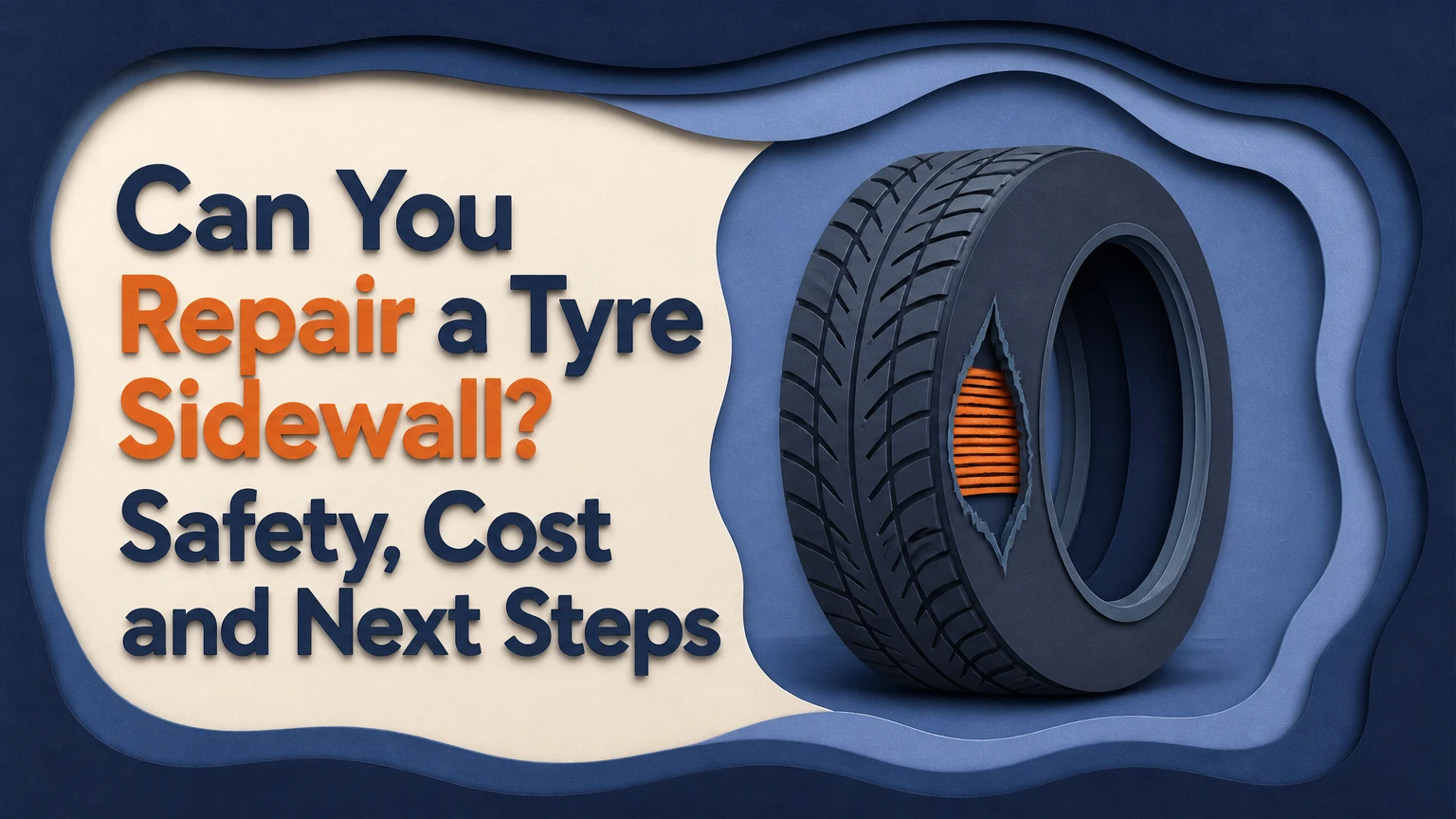
You cannot safely repair a passenger-car tyre sidewall puncture, tear, or structural cut with a plug or patch. A damaged sidewall can no longer be assumed to contain inflation pressure reliably, so the safe remedy is professional inspection followed by complete tyre replacement, not continued road use.
Key facts at a glance
A bulge or bubble usually indicates separated or broken internal cords and requires immediate replacement.
A plug, patch, sealant, inner tube, or glue cannot restore a damaged passenger-tyre carcass.
A shallow surface scuff may be cosmetic, but only an internal inspection can confirm that no cords are damaged.
Do not drive on a visibly bulging, cut, or deflated sidewall; fit the spare or arrange roadside recovery.
Typical replacement cost is about $80-$350 or more per tyre, including premium, specialty, and performance sizes.
Specialist vulcanizing repairs exist for some agricultural, mining, earthmover, and commercial tyres, not ordinary road-car tyres.
Can You Repair a Tyre Sidewall?
A passenger-vehicle sidewall is not a repair zone. Tyre manufacturers and industry repair guidance generally restrict permanent puncture repairs to the repairable tread area, after the tyre has been removed and inspected internally; sidewall injuries fall outside that procedure.
A sidewall plug is especially unsafe because the sidewall bends repeatedly as the wheel rotates. A patch attached to the inner liner may stop air loss briefly, but it does not reconstruct severed carcass cords or restore the tyre’s designed flex characteristics. The result can be sudden pressure loss, tread separation, or a blowout.
The legal wording differs by country, state, and inspection regime. Calling every sidewall repair “illegal” is too broad, but a sidewall-repaired passenger tyre can fail a roadworthiness inspection, breach a manufacturer’s instructions, or create an insurance dispute. The practical rule is consistent: replace the tyre unless a qualified tyre professional confirms that the mark is purely superficial.
What Is the Sidewall?
The tyre sidewall is the flexible vertical section between the tread shoulder and the bead. It protects the carcass, flexes under load, carries size and load markings, and transfers forces between the road-contacting tread and the wheel rim.
A radial passenger tyre typically contains rubber sidewalls over textile carcass cords, with steel belts concentrated beneath the tread rather than extending through the whole sidewall. The bead anchors the tyre to the rim, while the inner liner retains air in a tubeless assembly.
That construction explains the repair boundary. A puncture in the central tread can sometimes be cleaned, filled with a vulcanized rubber stem, and reinforced with an internal patch. A cut in the sidewall can damage the load-bearing carcass where no equivalent tread-belt reinforcement exists.
Why Is Sidewall Damage More Dangerous Than a Tread Puncture?
Sidewall damage is more dangerous because the sidewall is a load-bearing, continuously flexing part of the tyre carcass. Every wheel rotation bends the damaged area, generating heat and concentrating stress around injured cords, even when the tyre appears to hold air while parked.
A tread puncture is potentially repairable only when its size, location, angle, and the tyre’s internal condition meet recognized repair criteria. A puncture near the shoulder, bead, or sidewall is normally rejected because those areas flex or carry unusual stresses.
The U.S. Tire Manufacturers Association describes the accepted principle as: “Proper tire repair requires that the tire be removed from the wheel for a complete internal inspection.” That instruction matters because an external plug cannot reveal liner abrasion, moisture intrusion, or run-flat damage inside the casing.
A tyre that has been driven while underinflated needs separate inspection. Heat can damage the inner liner and carcass without leaving an obvious external mark. Pressure loss is therefore not the only issue; hidden structural damage determines whether the assembly remains serviceable.
Which Sidewall Damage Requires Replacement?
Bulges, bubbles, exposed cords, deep cuts, punctures, bead injuries, and cuts that open when the sidewall flexes require replacement. A shallow abrasion with intact rubber and no cord exposure may be cosmetic, but the tyre should still be examined if the impact was forceful or air pressure changed afterward.
| Visible condition | Likely internal issue | Safe decision |
|---|---|---|
| Bulge or bubble, 10-50 mm across | Broken or separated carcass cords | Replace immediately |
| Cut with fabric or steel visible | Severed protective rubber and cords | Replace immediately |
| Puncture in sidewall, any ordinary nail or screw | Air-retention and carcass injury | Replace, do not plug |
| Curb scuff under 1 mm deep, no cord showing | Surface rubber abrasion | Professional inspection |
| Abrasion with cords showing | Structural carcass exposure | Replace immediately |
| Bead cut or rim-flange damage | Seating and air-seal failure | Stop driving and replace or repair the wheel as diagnosed |
A sidewall marking that is scratched or partly removed is not automatically structural damage. The concern is the rubber and carcass beneath the lettering, not the loss of cosmetic text. Conversely, a small-looking incision can penetrate several cord layers.
How Can You Tell a Scuff From a Structural Cut?
A cosmetic scuff usually leaves a broad, shallow smear without an open edge, bulge, air leak, or visible cord. A structural cut has a sharp groove, separated lips, trapped debris, exposed fabric, a raised bubble, or a shape that changes when the tyre is loaded.
Do not press a bulge, scrape the injury with a tool, or spray flammable substances onto the tyre. Photograph the area, check pressure only with a gauge if the tyre is not visibly compromised, and ask a tyre technician to inspect it removed from the wheel.
A tyre can look acceptable from the outside while suffering inner-sidewall abrasion. This is common after a vehicle travels several hundred metres on low pressure. The technician should inspect both sidewalls, the inner liner, bead area, and rim for impact damage.
Can You Drive on a Damaged Sidewall?
Do not drive on a tyre with a bulge, exposed cords, an open sidewall cut, a rapid leak, or a flat casing. Driving even a short distance can convert a repairable wheel or recoverable vehicle into a tyre failure, rim-damage, or loss-of-control event.
Move the vehicle only if necessary to reach a safe position, and keep that movement at walking speed over the shortest practical distance. Do not drive to a tyre shop on a visibly damaged tyre. Use a correctly inflated spare, a manufacturer-approved mobility system, or roadside recovery.
| Situation | Immediate action | Road-driving advice |
|---|---|---|
| Bulge on a parked vehicle | Keep occupants away from traffic; arrange recovery | Do not drive |
| Slow leak with no visible sidewall injury | Check pressure and inspect promptly | Drive only if a professional confirms it is safe |
| Sidewall cut with cords visible | Do not inflate repeatedly or manipulate the cut | Do not drive |
| Flat tyre with a temporary spare available | Install the specified spare | Follow its speed and distance limits |
| Run-flat warning with no visible damage | Follow the vehicle handbook | Use the run-flat distance limit, then inspect |
| No spare and tyre damaged | Call roadside assistance | Do not rely on sealant or a compressor |
A compressor can restore pressure but cannot restore structural strength. Tyre sealant can sometimes address a small tread puncture in an emergency, depending on the vehicle maker’s instructions, but it is not a sidewall repair and may interfere with TPMS sensors.
Are Any Sidewall Repairs Ever Possible?
Specialist section repairs can be possible on selected agricultural, earthmover, mining, industrial, and heavy commercial tyres. The work involves removing damaged casing material, evaluating and replacing reinforcement, applying rubber compounds, and curing the repair under controlled workshop conditions.
That exception does not apply to a normal passenger-car, SUV, motorcycle, or light-truck tyre. Large off-the-road tyres have different casing designs, repair economics, operating speeds, and manufacturer procedures. A certified repair facility decides whether the casing is suitable; a consumer repair kit cannot duplicate that process.
Off-road recovery products, sewn repairs, and thick plugs may help an expedition vehicle leave a remote trail at very low speed. They are recovery measures, not a return-to-service certification. A tyre used that way should be removed from road use and assessed or discarded afterward.
| Tyre category | Specialist repair possibility | Typical decision |
|---|---|---|
| Passenger car, 15-19 inch | Sidewall repair not accepted | Replace |
| Light truck or van, highway use | Sidewall repair generally not accepted | Replace unless manufacturer-specific guidance says otherwise |
| Agricultural tractor tyre | Section repair may be available | Certified vulcanizer assessment |
| Mining or earthmover tyre | Major casing repair may be economical | Specialist facility only |
| Low-speed off-road tyre | Emergency field repair may aid recovery | Remove from public-road service |
| Motorcycle tyre | Sidewall repair not accepted | Replace |
Manufacturers and repair organizations do not use one universal “15 mm from the sidewall” rule for every tyre. Repair boundaries depend on the tyre design and published policy. The reliable distinction is the repairable tread area, not a DIY measurement that happens to be below a particular number.
What Does a Replacement Cost and How Long Does It Take?
A typical passenger-vehicle sidewall replacement costs about $80-$350 or more per tyre in the United States, with the final price determined by size, brand, run-flat construction, load rating, wheel diameter, taxes, disposal, balancing, and installation. A standard in-stock tyre often takes 30-60 minutes to fit.
A premium 20-inch run-flat or an uncommon performance tyre can exceed $350 before alignment or additional services. Commercial and industrial section repairs commonly cost roughly $150-$500 or more, but that range is a typical planning figure rather than a universal quotation.
| Service or option | Typical US cost | Typical time | Main limitation |
|---|---|---|---|
| Standard replacement tyre | $80-$180 | 30-60 minutes | Availability varies |
| Premium, large, or performance tyre | $180-$350+ | 45-90 minutes | Higher fitting and balancing costs |
| Run-flat replacement | $180-$450+ | 45-90 minutes | Specialized equipment may be needed |
| Used matching tyre | $40-$150 | 30-60 minutes | Age, history, and tread condition must be checked |
| Wheel and tyre recovery | $75-$250 | 30-120 minutes | Location and after-hours rates vary |
| Heavy-tyre section repair | $150-$500+ | 1-2 days or longer | Certified facility and casing suitability |
Ask the shop to quote the complete fitted price. Confirm the tyre’s size, load index, speed rating, construction, production date, balancing, valve or TPMS service, disposal fee, and road-hazard coverage before authorizing replacement.
Should You Replace One Tyre or Two?
Replace at least the damaged tyre, but replacing two tyres on the same axle is often preferable when the opposite tyre has substantial wear. Matching tread depth improves left-to-right handling and braking consistency, while all-wheel-drive vehicles may require a narrower tread-depth difference specified by the vehicle manufacturer.
There is no universal rule that every damaged tyre demands four new tyres. Front-wheel-drive and rear-wheel-drive vehicles can often use one replacement when the matching tyre is nearly new and the specifications are identical. AWD systems are more sensitive because circumference differences can create driveline speed variation.
| Vehicle situation | Replacement approach | Verification required |
|---|---|---|
| Two-wheel drive, matching tyre under 3,000 miles old | One identical tyre may be reasonable | Same size, rating, model, and tread pattern |
| Same axle has 4-5 mm tread difference | Replace the pair or shave a replacement if available | Manufacturer and tyre-shop guidance |
| AWD vehicle with one damaged tyre | Assess all four circumferences | Owner’s manual or AWD manufacturer limit |
| Mixed front and rear sizes | Replace the specified position only | Vehicle placard and fitment data |
| Temporary spare installed | Use only within handbook limits | Speed and distance restrictions |
For a budget replacement, a reputable used tyre can be safer than a patch, but inspect the DOT or date code, tread depth, sidewalls, repairs, uneven wear, and storage history. Avoid any used tyre with a bulge, exposed cord, bead injury, previous sidewall repair, or unknown damage history.
What Should You Do After Finding Sidewall Damage?
Follow a controlled inspection and recovery sequence rather than attempting a repair. The sequence takes about 5-10 minutes for an initial visual assessment, but a final safety decision requires the tyre to be removed and examined by a qualified technician.
- Stop in a safe location. Switch on hazard lights, apply the parking brake, and keep away from traffic.
- Do not remove an embedded object. Removing a screw or fragment can increase air loss, although a sidewall puncture still requires replacement.
- Photograph the damage. Capture the full tyre, close-up injury, wheel, and vehicle position for the shop or insurer.
- Check for emergency equipment. Locate the spare, jack, locking-wheel-nut key, inflator, and vehicle handbook.
- Inspect the opposite sidewall and rim. A pothole or curb strike can damage the unseen inner side and bend the wheel.
- Use the spare or call recovery. Follow the temporary-spare speed and distance limits exactly.
- Request a full inspection. Ask for casing, bead, rim, alignment, TPMS, and the other tyres to be checked.
- Replace with a correct specification. Match size, load index, speed rating, construction, and vehicle-approved fitment.
You will know the process is complete when the replacement is correctly seated, balanced, inflated to the door-placard pressure, and the TPMS warning has been reset or relearned where required. A visual plug or patch on the sidewall is not a success checkpoint.
What Mistakes Make Sidewall Damage Worse?
The most serious mistakes are treating the sidewall like the tread, hiding a casing injury with an inner tube, and driving because the tyre has not yet gone flat. Each choice preserves the appearance of mobility while leaving the damaged load-bearing structure unchanged.
- Installing a rope plug: A plug seals a channel; it does not rebuild sidewall cords.
- Applying an inside patch: Adhesive rubber may cover the liner but cannot replace separated reinforcement.
- Adding an inner tube: A tube does not make a damaged tubeless casing safe and can create heat or fitment problems.
- Using tyre sealant: Sealant addresses some punctures, not cuts, bubbles, or carcass separation.
- Inflating a bulged tyre: Additional pressure can increase stress at the failed cord zone.
- Driving slowly to a shop: Low speed reduces some heat but does not eliminate cyclic flex or sudden failure.
One useful practitioner rule is simple: if a sidewall injury changes shape under load, assume the carcass is compromised. Do not rely on the fact that the tyre holds air for an hour or overnight.
What If the Tyre Is a Run-Flat or Has TPMS?
Run-flat tyres may permit limited travel after pressure loss, but run-flat capability does not make sidewall damage repairable. Follow the vehicle handbook’s maximum speed, distance, and inspection instructions, because limits commonly depend on load, temperature, and whether the warning was noticed promptly.
A TPMS warning reports pressure loss or sensor data; it does not diagnose cord damage. A tyre can show normal pressure after a temporary inflation while still having a dangerous bulge or impact injury. TPMS therefore supplements, rather than replaces, a physical inspection.
If the tyre has been driven deflated beyond the manufacturer’s limit, ask the technician to inspect the inner liner for abrasion and heat damage. Run-flat sidewalls are reinforced and may feel unusually stiff, so visual and tactile inspection by an equipped shop matters.
How Can You Reduce the Cost Without Risking Safety?
The safest ways to reduce cost are choosing a correctly rated mid-range tyre, comparing the full fitted price, checking warranty or road-hazard coverage, and asking whether the unworn matching tyre can remain in service. A cheap sidewall patch is not a legitimate cost-saving option because it leaves the primary failure risk unresolved.
If a single tyre is needed, search by the complete fitment rather than by diameter alone. The replacement must match the vehicle’s approved size, load index, speed rating, construction, and, for some AWD systems, tread circumference.
A used tyre can be a reasonable temporary budget choice when its age, history, and condition are known. Measure tread depth across several points, inspect the inner and outer sidewalls, verify the date code, and reject repairs or irregular wear that suggest prior underinflation.
When Is a Wheel Also Unsafe?
A wheel also needs inspection after a pothole or curb impact because a bent flange can cause a leak, bead damage, vibration, or incorrect tyre seating. A replacement tyre cannot correct a cracked alloy wheel, a distorted steel rim, or a burr cutting the bead.
Request wheel runout and bead-seat inspection when the tyre lost pressure immediately after impact, the steering wheel vibrates, the vehicle pulls, or the new tyre will not hold pressure. Alignment may also be necessary, but alignment cannot repair a damaged rim or tyre carcass.
FAQ
Can a nail in the tyre sidewall be repaired?
No. A nail or screw through a passenger-tyre sidewall is not a standard puncture repair, even if the object is small and the leak is slow. Leave the object in place until inspection, avoid driving on the tyre, and use a spare or recovery service before arranging replacement.
Is a sidewall scuff safe to drive on?
A shallow sidewall scuff can be safe if it affects only surface rubber, shows no cords, has no open edge or bulge, and followed no pressure loss. Because external inspection cannot reveal every inner injury, have a tyre professional examine a scuffed tyre after a hard curb strike.
Can tyre sealant fix a sidewall cut?
Tyre sealant cannot restore a cut sidewall or replace damaged carcass cords. Sealant products are designed for limited puncture scenarios, and many vehicle manufacturers restrict their use, especially with TPMS or run-flat systems. A sidewall cut requires replacement and inspection of the wheel.
Do I need to replace all four tyres?
Not automatically. Replace the damaged tyre, then compare the remaining tyres’ tread depth, age, specification, and condition. Replace a pair when the same axle has a significant wear difference, and consult the vehicle manufacturer before fitting one tyre on an AWD vehicle.
Can a motorcycle tyre sidewall be repaired?
A motorcycle tyre sidewall should not be repaired with a plug, patch, tube, or adhesive. Motorcycle tyres experience high cornering loads and lean angles, so a sidewall injury requires replacement and inspection of the rim, bead, and related suspension after an impact.
Can a tractor or mining tyre sidewall be repaired?
Some agricultural, mining, earthmover, and industrial tyres can receive a specialist section repair or vulcanized casing repair. The tyre must go to a qualified major-repair facility, where casing condition, operating speed, load, and manufacturer procedures determine viability. That exception does not transfer to passenger tyres.
The Bottom Line
You cannot safely repair a passenger-vehicle sidewall puncture, tear, bulge, or exposed-cord injury with a DIY kit or ordinary tyre-shop patch. Stop driving, use the spare or roadside recovery, and have the tyre and wheel inspected before replacement. The answer to “can you repair a tyre sidewall” is no for normal road-car tyres, with specialist heavy-tyre vulcanization as a separate industrial exception.