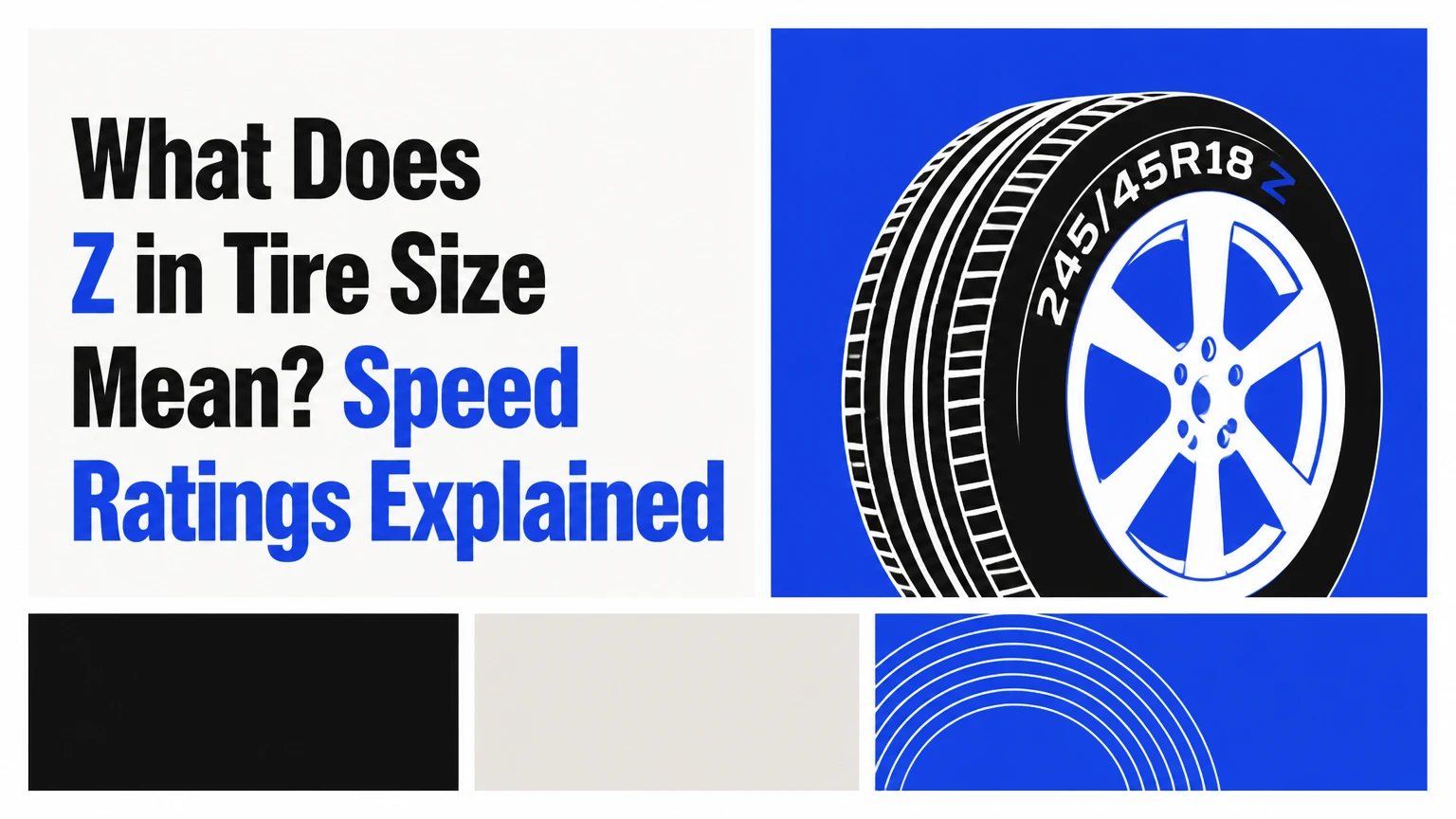
A “Z” in a tire size designation (such as 245/40ZR18) indicates that the tire is engineered for high-performance speed capabilities exceeding 149 mph (240 km/h) under maximum load. Unlike modern single-letter speed codes that appear at the end of a service description, the historical “Z” is embedded directly within the construction type layout of the sidewall.
At a Glance
- The “Z” designation signifies an absolute speed capability greater than 149 mph (240 km/h).
- Modern tires with a “Z” usually include a trailing service description containing a W, Y, or parenthesized (Y) rating to specify the exact ceiling.
- ZR tires feature specialized internal carcass reinforcements and softer rubber compounds designed to manage extreme heat generation.
- Lowering a vehicle’s tire speed rating from factory-specified ZR tires to standard commuter tires can compromise handling responsiveness and accelerate shoulder wear.
- Mixing ZR-rated tires with standard radial tires across the same axle creates severe handling imbalances and braking instability.
What Does Z in Tire Size Mean?
The letter “Z” in a tire size indicates that the tire is structurally certified to handle sustained vehicle speeds above 149 mph (240 km/h). Originating from a time when 149 mph represented the absolute ceiling for production sports cars, the “Z” remains an open-ended historical designation embedded within the tire’s construction code, such as the “ZR” found in 245/40ZR18.
Because vehicle engineering advanced past that initial 149 mph threshold, tire manufacturers adapted the system. Today, the standalone “Z” is almost always paired with a secondary service description located further down the sidewall. This secondary code provides the exact upper velocity limit for the tire carcass. Drivers replacing original equipment must understand that the “Z” is no longer just a single speed rating, but rather an architectural indicator of high-speed structural integrity.
What Are the Specific Speed Ratings Associated with Modern ZR Tires?
Modern tires featuring a “Z” in their size string rely on specific alphanumeric service descriptions at the end of the sidewall to denote their precise operational limits. These ratings establish the legal and structural boundaries for vehicle velocity under maximum load conditions.
- W Rating: Certified for sustained speeds up to 168 mph (270 km/h).
- Y Rating: Certified for sustained speeds up to 186 mph (300 km/h).
- (Y) Rating: Enclosed in parentheses, this rating indicates the tire is certified for speeds exceeding 186 mph (300+ km/h) under custom manufacturer testing protocols.
When inspecting a sidewall reading like 245/40ZR18 97W, the “ZR” points to high-speed pedigree, while the final “W” provides the exact numerical boundary. Ignoring these trailing letters when purchasing replacement rubber can introduce severe safety hazards during aggressive driving or track sessions.
What Is the Difference Between a Standard Y Speed Rating and a Parenthesized (Y) Rating?
A standard Y speed rating establishes a strict legal and operational ceiling of 186 mph, whereas a parenthesized (Y) rating signifies that the tire has been tested to safely exceed 186 mph. This distinction is critical for owners of ultra-high-performance supercars and track-day enthusiasts.
When a tire displays a service description such as 96Y, the tire manufacturer guarantees structural integrity up to 186 mph under optimal inflation and load conditions. If the load index and speed symbol are enclosed in parentheses like (96Y), the tire possesses enhanced internal cap plies and advanced belt packages designed to withstand extreme centrifugal forces at velocities well north of 186 mph. Installing standard Y-rated tires on a vehicle capable of sustained speeds beyond that threshold risks catastrophic tread separation due to internal heat accumulation.
How Do Z and ZR Placements Differ Between Passenger Cars and Motorcycles?
On passenger vehicles, the “Z” is permanently integrated with the internal construction designation, appearing as “ZR” (such as 235/40ZR18) to denote a radial tire built for high speeds. On many high-performance motorcycle tires, the letter “Z” stands completely alone or is separated from the layout (such as 120/70 ZR 17), yet it carries identical speed implications.
This structural placement variation reflects how different vehicle classes manage load and centrifugal stress. Passenger car sidewalls experience heavy lateral cornering forces combined with vehicle mass, requiring the Z to modify the radial (R) designation directly. Motorcycle tires, dealing with lean angles and high rotational speeds on narrower contact patches, often feature the Z as an independent milestone marker before the rim diameter. Despite this visual formatting difference on the sidewall, both automotive and motorcycle Z designations require strict adherence to matching service descriptions.
What Does a Pure “Z” Without Trailing Codes Mean on Vintage Cars?
A pure “Z” tire size containing no trailing load or speed letters (such as 225/50ZR16 found on classic sports cars from the 1980s and early 1990s) indicates a legacy high-performance tire certified exclusively for the baseline threshold of 149 mph (240 km/h). These vintage specifications predate the modern standardized service description system.
Restorers and collectors operating vintage performance vehicles must exercise extreme caution with legacy sizing. Because modern tire manufacturers rarely produce exact replica compounds for obsolete sizing, finding replacement rubber often requires transitioning to modern ZR tires with explicit service descriptions. Mechanics recommend verifying that any replacement tire matches or exceeds the original load index of the vehicle, even when dealing with vintage un-serviced “Z” markings.
Why Does Replacing a ZR Tire with a Standard T or H Tire Affect Handling at Normal Speeds?
Replacing a factory-specified ZR tire with a standard T or H commuter tire alters vehicle handling dynamics, reducing steering responsiveness and cornering grip even during normal legal speed limits. This degradation occurs because ZR tires utilize fundamentally different internal architectures than standard touring tires.
ZR tires feature significantly stiffer sidewalls, reinforced shoulder blocks, and specialized nylon cap plies designed to resist high-speed centrifugal growth. Standard commuter tires prioritize ride comfort and low rolling resistance through flexible sidewalls. When a driver installs softer-sidewall tires on a vehicle engineered for ZR performance, the vehicle will exhibit noticeable steering lag, delayed turn-in response, and premature shoulder wear during routine cornering maneuvers due to excessive sidewall rollover.
How Does High Speed Affect the Load-Carrying Capacity of a Z-rated tire?
As a Z-rated tire approaches its upper velocity limit, its physical weight-carrying capacity decreases. Standard tire load indices are calculated at baseline testing speeds, but extreme high-speed operation generates intense internal heat and centrifugal force that reduces the tire’s structural load margin.
Drivers operating a fully loaded vehicle at velocities near a tire’s maximum speed rating risk overloading the tire carcass, even if the total weight stays below the maximum placard limit at a standstill. Professional racing teams and high-performance driving instructors account for this downward sliding scale by reducing vehicle payload or stepping up to higher-rated (Y) or parenthesized (Y) tires when sustained high-speed driving is anticipated. Ignoring this engineering reality creates a severe blowout risk on long highway runs or track days.
Is a ZR Tire Physically Wider or Larger than a Standard R Tire?
A ZR tire has the exact same section width, aspect ratio, and rim diameter as a standard R tire sharing the same dimensional string. For example, a 235/40ZR18 tire matches the physical outer dimensions and mounting specifications of a 235/40R18 tire.
The fundamental differences between these two tires lie entirely beneath the tread surface. While both tires mount to the same wheel width and fit identical wheel wells, the ZR variant incorporates denser polyester body plies, high-tensile steel belts, and specialized jointless cap plies to manage thermal degradation. Drivers can safely swap between standard and performance constructions regarding physical fitment, provided the load and speed ratings align with vehicle manufacturer requirements.
Can I Mix ZR Tires with Standard R Tires on the Same Vehicle?
Mixing ZR-rated tires and standard R tires across the same axle is unsafe and should be avoided under all circumstances. Mismatched tire constructions create dangerous handling imbalances, unpredictable grip thresholds under hard braking, and potential electronic stability control system failures.
Because ZR tires feature rigid sidewalls and high-tread-stiffness compounds while standard radials offer flexible sidewalls and compliant ride qualities, putting them on the same axle results in uneven slip angles. During emergency braking or evasive steering maneuvers, the mismatched axles will react at different rates, causing sudden oversteer or understeer. Industry best practice mandates replacing tires in complete matching sets of four, or at minimum, matching axles with identical speed ratings and construction types.
Do Z-rated tires wear out faster than normal commuter tires?
Z-rated tires wear out faster than standard all-season commuter tires, frequently delivering lower overall mileage life spans. This accelerated wear is a direct mechanical trade-off required to achieve exceptional high-speed traction and cornering stability.
To maintain grip during aggressive cornering and high-temperature operation, ZR tires utilize softer, high-hysteresis rubber compounds that grip the asphalt more aggressively than hard, long-wearing commuter compounds. Furthermore, high-performance tread patterns often feature larger tread blocks with fewer sipes to prevent squirm under heavy loads. Drivers transitioning from standard touring tires to ultra-high-performance summer ZR tires should expect shorter replacement intervals, typically ranging between twenty thousand and thirty thousand miles depending on driving style and alignment settings.
How Can I Read the Full Service Description Code Following a ZR Rating?
Decoding a full service description requires analyzing the numbers and letters trailing the primary size sequence, such as decoding the 97W in 245/40ZR18 97W. The number represents the load index, while the trailing letter represents the maximum speed capability.
- Load Index Number (97): Corresponds to a maximum weight-carrying capacity per tire, where 97 equals 1,609 pounds (730 kg) at maximum inflation pressure.
- Speed Symbol Letter (W): Identifies the terminal speed capability, corresponding in this instance to 168 mph.
Vehicle owners must reference the tire placard located inside the driver-side door jamb to ensure replacement tires meet or exceed both the numeric load index and alphabetic speed rating specified by the original manufacturer.
What Are the Legal Implications of Installing Tires with a Lower Speed Rating than Factory Specifications?
Installing replacement tires with a lower speed rating than the vehicle manufacturer’s original equipment specification can compromise vehicle safety, void mechanical warranties related to suspension components, and create potential liability issues in the event of an accident caused by tire failure.
While most retail tire shops enforce strict corporate policies refusing to install tires with lower speed ratings than original equipment, DIY purchasers must exercise caution. Dropping from a factory-mandated ZR rating down to a standard S or T rating alters the dynamic envelope of the vehicle. If a vehicle is capable of exceeding the maximum speed of the installed lower-rated tire, high-speed driving can induce catastrophic tread separation, shifting legal and financial liability onto the vehicle operator.
How Do Stiffer Sidewalls and Soft Rubber Compounds on ZR Tires Impact Fuel Economy and Road Noise?
ZR tires generate higher road noise and slightly lower fuel economy compared to standard low-rolling-resistance touring tires. These acoustic and efficiency trade-offs are the direct mechanical consequence of the heavy internal reinforcement and sticky tread compounds engineered into high-performance tires.
The stiff sidewalls and dense steel belts required to maintain high-speed structural integrity prevent the tire from absorbing minor road imperfections efficiently, transmitting more vibration and frequency resonance into the cabin. Additionally, the soft rubber compounds required for maximum cornering traction increase rolling resistance. Drivers prioritizing a quiet, fuel-efficient highway commute often experience a noticeable increase in cabin decibel levels and a minor drop in miles per gallon when switching to aggressive summer ZR tires.
What Specific Maintenance Habits Extend the Life of High-Performance ZR Tires?
Maximizing the lifespan of expensive ZR tires requires diligent maintenance habits, specifically maintaining precise inflation pressures, executing frequent tire rotations, and preserving strict wheel alignment specifications. Because ZR tires feature stiff sidewalls and soft compounds, neglect accelerates uneven wear patterns.
- Monthly Inflation Checks: Operating ZR tires underinflated causes extreme heat buildup in the shoulders, leading to rapid tread destruction.
- Biannual Wheel Alignment: High-performance suspension geometry combined with soft rubber compounds makes ZR tires exceptionally sensitive to toe and camber misalignments.
- Frequent Rotations: Rotating performance tires every five thousand miles ensures even wear across staggered or non-staggered fitments.
Adhering to these maintenance protocols prevents premature inner-shoulder wear and ensures the tire reaches its maximum expected mileage threshold.
Why Do Luxury Sedans and Heavy Electric Vehicles Require ZR-Designated Tires Even if They Rarely Exceed Highway Speeds?
Heavy luxury sedans and high-torque electric vehicles require ZR-designated tires despite rarely exceeding legal highway speed limits because of vehicle weight, instantaneous torque delivery, and high cornering loads. These modern applications push immense static and dynamic forces through the tire contact patch.
Electric vehicles impose massive initial torque loads onto the drive wheels upon acceleration, which quickly shreds standard tire rubber. Furthermore, the sheer battery weight of modern luxury EVs creates severe lateral scrubbing forces during cornering. ZR-designated casings provide the robust internal sidewall stiffness and heavy-duty load architectures necessary to support heavy vehicles through hard cornering without experiencing structural rollover or premature tread failure.
How Do Winter Weather Conditions and Cold Temperatures Affect the Performance of Z-rated Rubber Compounds?
Winter weather and freezing temperatures degrade the performance of summer ZR tires, causing the specialized rubber compounds to harden, lose traction, and risk structural cracking. Summer high-performance tires are engineered to operate in ambient temperatures above 45°F (7°C).
When temperatures drop below freezing, the high-hysteresis polymers in summer ZR tread compounds transition into a glass-like state, resulting in a dramatic loss of grip on dry, wet, or snowy roads. Operating summer ZR tires in freezing conditions creates dangerous driving dynamics and can cause micro-cracking in the tread grooves. Drivers living in regions with sub-freezing winters must transition to dedicated winter tires or all-weather tires bearing the Three-Peak Mountain Snowflake (3PMSF) symbol.
The Bottom Line
Understanding the “Z” in tire size requires looking past the historical 149 mph threshold to evaluate the complete sidewall specification, including modern W, Y, and parenthesized (Y) service descriptions. While ZR tires offer superior high-speed stability, responsive steering feedback, and robust cornering grip for performance vehicles and heavy applications, they demand strict adherence to inflation maintenance, proper rotation schedules, and exact speed rating replacements to ensure safety.