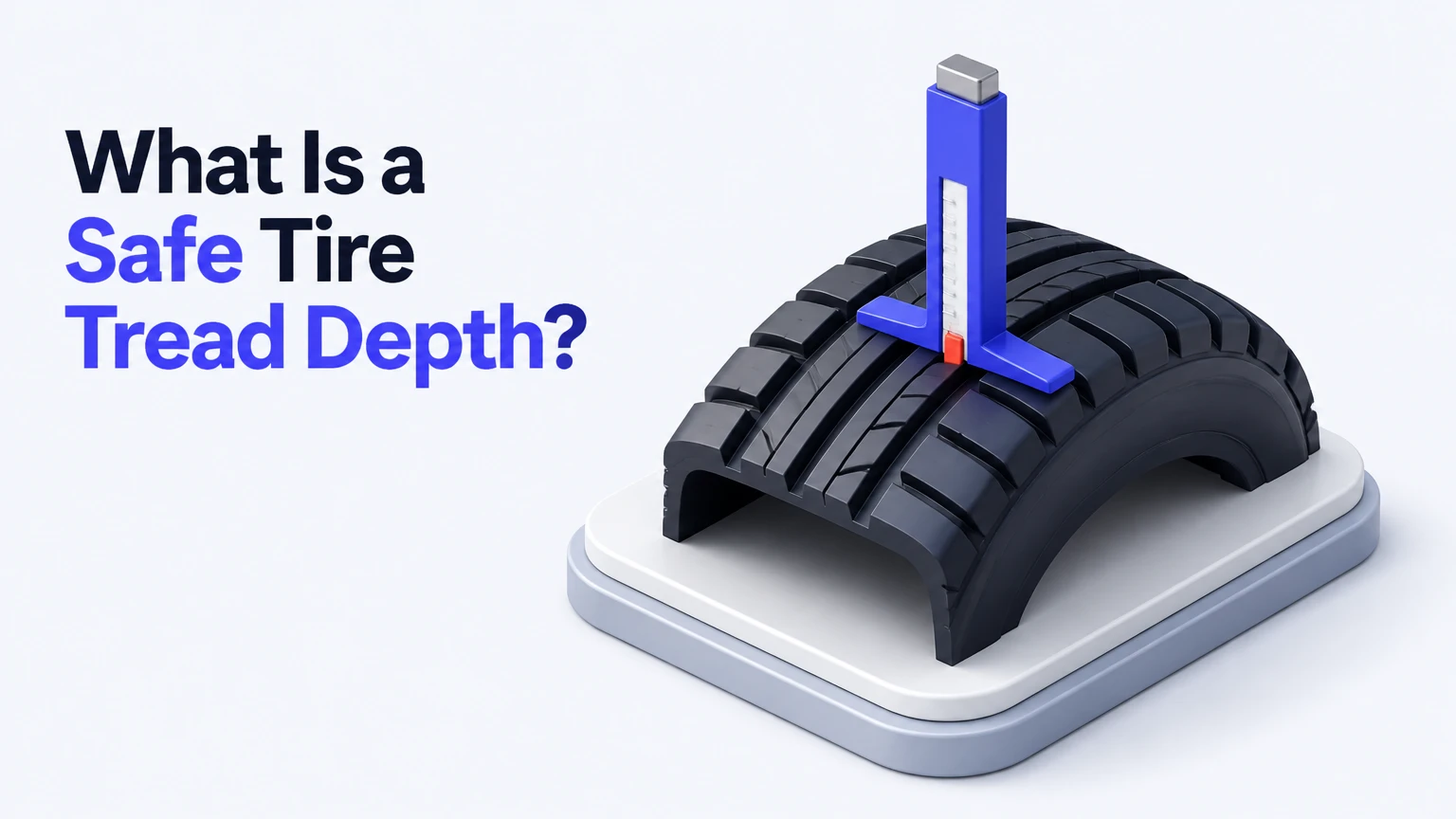
A safe tire tread depth for standard driving conditions is $4/32$ of an inch ($3.18\text{ mm}$) or deeper, which ensures optimal water evacuation and grip. While the absolute legal minimum across most jurisdictions is $2/32$ of an inch ($1.59\text{ mm}$), tires worn to this level exhibit significantly reduced traction, increased stopping distances, and high risks of hydroplaning during wet weather.
At a Glance: Tire Tread Safety Facts
- Standard driving safety requires a minimum tread depth of $4/32$ of an inch ($3.18\text{ mm}$).
- The absolute legal minimum threshold across most regions is $2/32$ of an inch ($1.59\text{ mm}$).
- Wet braking distances at $60\text{ mph}$ increase by up to $100\text{ feet}$ when tires drop from $10/32$ to $2/32$ of an inch.
- Winter and snow tires lose functional snow traction once wear reaches $5/32$ to $6/32$ of an inch.
- Tire safety is determined by the lowest measurement on the tire, making uneven wear patterns critical to monitor.
What Is the Absolute Legal Minimum Tire Tread Depth?
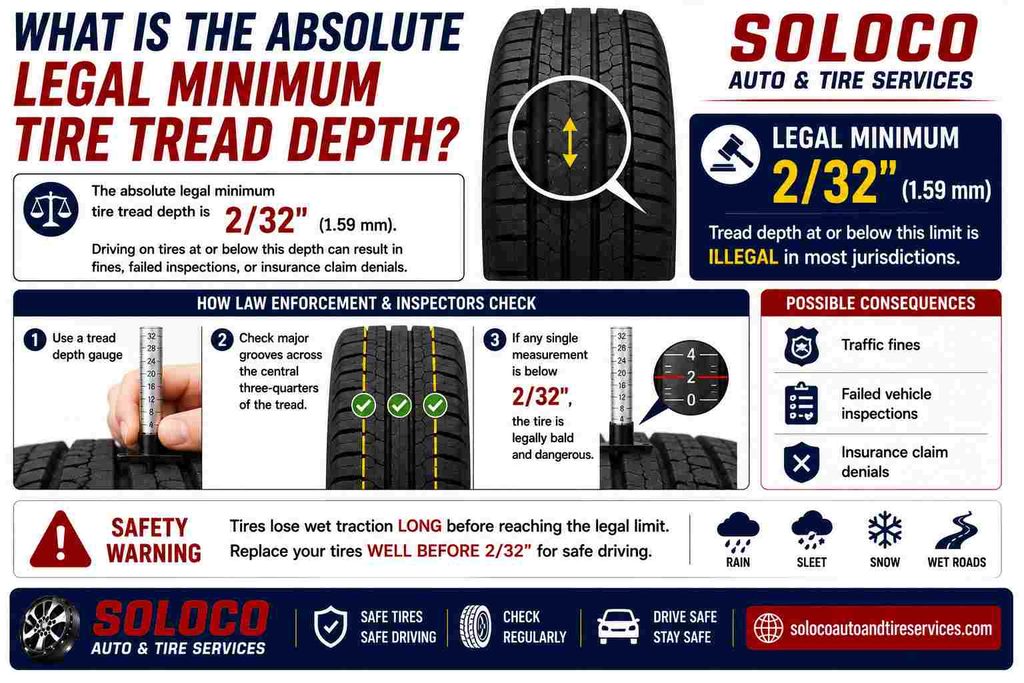
The absolute legal minimum tire tread depth is $2/32$ of an inch ($1.59\text{ mm}$). Operating a vehicle on public roads with tread depth at or below this threshold violates traffic laws in most jurisdictions and can result in fines, failed vehicle inspections, or insurance claim denials following an accident.
Law enforcement officers and vehicle inspectors use tread depth gauges to check major grooves across the tire surface. If any single measurement across the central three-quarters of the tread falls below $2/32$ of an inch, the tire is legally considered bald and dangerous. Waiting until this legal limit is reached, however, compromises vehicle safety because wet traction degrades severely long before the tire becomes illegal. Drivers who regularly encounter rain, sleet, or snow should replace tires well in advance of this threshold.
What Do Different Tire Tread Depth Measurements Mean for Safety?
Tire tread depth measurements dictate how effectively rubber interacts with varying road surfaces, water layers, and weather conditions. Evaluating specific millimeter and inch ranges allows drivers to categorize tire health and schedule proactive replacements.
- $10/32$ to $12/32$ Inches ($7.9\text{ mm}$ to $9.5\text{ mm}$): Excellent condition. Brand new tires provide maximum biting edges and channel large volumes of water away safely.
- $5/32$ to $9/32$ Inches ($4.0\text{ mm}$ to $7.1\text{ mm}$): Good condition. Tires remain completely safe for normal driving, though monthly visual and physical inspections are recommended.
- $4/32$ Inches ($3.2\text{ mm}$): Passing condition. This threshold marks the recommended replacement point for vehicles frequently driven in heavy rain, standing water, or winter climates.
- $3/32$ Inches ($2.4\text{ mm}$): Marginal condition. Drivers must schedule immediate replacements and exercise extreme caution when navigating wet roads.
- $\le 2/32$ Inches ($\le 1.6\text{ mm}$): Failed condition. Tires are legally bald and must be replaced immediately to eliminate high hydroplaning risks.
How Do I Accurately Measure Tread Depth Without a Professional Gauge?
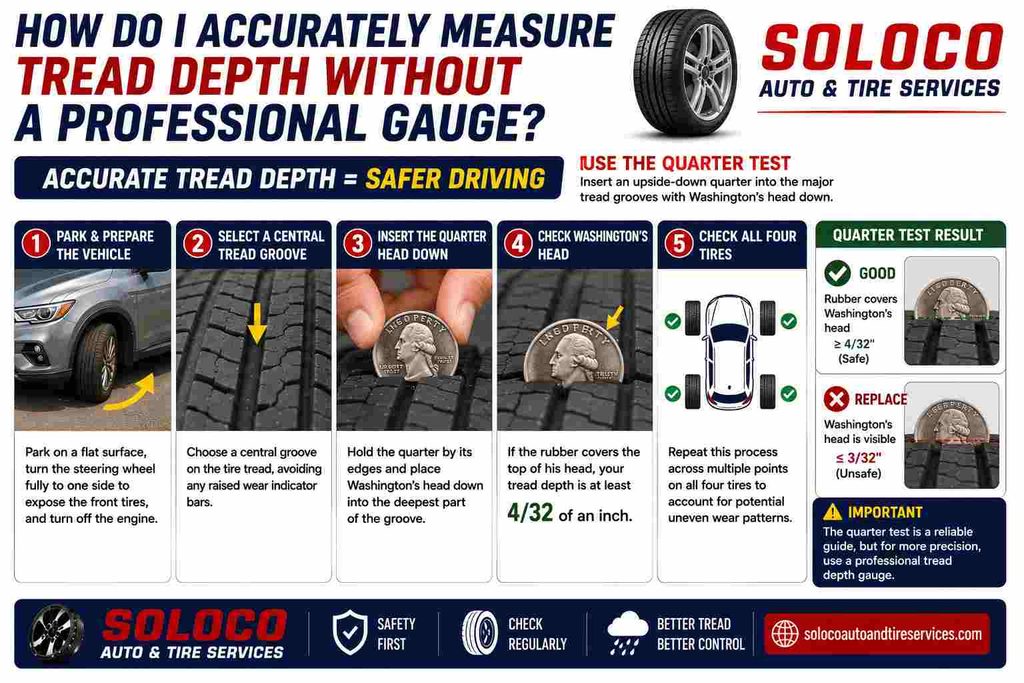
Accurately measuring tire tread depth without a professional depth gauge is easily accomplished using the Quarter Test. Insert an upside-down quarter into the major tread grooves of the tire with George Washington’s head facing downward into the rubber.
- Park the vehicle on a flat surface, turn the steering wheel fully to one side to expose the front tires, and turn off the engine.
- Select a central groove on the tire tread, avoiding any raised wear indicator bars.
- Hold the quarter by its edges and place Washington’s head down into the deepest part of the groove.
- Observe the top of Washington’s head; if the rubber covers the top of his head, your tread depth is at least $4/32$ of an inch.
- Repeat this process across multiple points on all four tires to account for potential uneven wear patterns.
How Does Worn Tread Depth Increase Braking Distance in Rain?
Worn tire tread depth drastically increases braking distances on wet roads because shallow grooves lack the volume required to channel water away from the contact patch. At $60\text{ mph}$ ($96.5\text{ km/h}$), a tire with $2/32$ of an inch of tread requires up to $100\text{ feet}$ ($30.5\text{ meters}$) more stopping distance in the rain than a brand new tire with $10/32$ of an inch of tread.
When water cannot escape through the grooves quickly enough, it builds up underneath the rubber contact patch, creating a wedge of water that lifts the tire off the road surface. This phenomenon, known as hydroplaning, causes a total loss of steering and braking control. Maintaining a tread depth of $4/32$ of an inch or higher preserves essential water evacuation channels, keeping stopping distances manageable and maintaining driver control during sudden downpours.
Why Is the Penny Test Flawed for Checking Tire Tread Safety?
The penny test is fundamentally flawed as a comprehensive safety indicator because it only evaluates whether a tire has reached the absolute legal minimum limit of $2/32$ of an inch. Using a penny with Lincoln’s head inserted into the tread only alerts you when a tire is already completely worn out and dangerous.
The penny test provides zero warning when a tire enters the high-risk marginal zone between $3/32$ and $4/32$ of an inch. Relying solely on Lincoln’s head being covered leaves motorists driving on dangerously compromised rubber during wet weather. Experts recommend upgrading to the quarter test or using a digital depth gauge to catch tire degradation before wet traction fails entirely.
How Does Tire Age Affect Safety Regardless of Tread Depth?
Tire age compromises structural safety regardless of remaining tread depth because rubber compounds degrade, harden, and oxidize over time. A tire stored in a garage or vehicle that sees minimal mileage may retain a pristine $10/32$ of an inch of tread after eight or ten years, yet remain unsafe for highway speeds.
Chemical softeners inside the rubber evaporate over time, causing microscopic surface cracks known as dry rot or sidewall cracking. These structural fissures weaken the internal steel belts and polyester cords, significantly increasing the risk of sudden tread separation or blowouts. Most tire manufacturers and safety organizations recommend inspecting tires annually after five years of service and replacing all tires once they reach ten years from their Department of Transportation (DOT) manufacturing date stamp, even if the tread appears deep.
When Do Winter and Snow Tires Lose Their Effectiveness?
Winter and snow tires lose their functional effectiveness when tread wear reaches $5/32$ to $6/32$ of an inch ($4.0\text{ mm}$ to $4.8\text{ mm}$). Unlike standard all-season tires, winter tires rely on deep sipes and aggressive void ratios to compress and pack snow into the tread blocks, generating traction through snow-on-snow friction.
As winter tires wear down below $5/32$ of an inch, the micro-channels lose the depth required to pack snow effectively, resulting in severe losses of acceleration and braking grip on ice and unplowed roads. Many dedicated winter tires feature secondary raised wear bars, known as snow platforms, molded into the grooves. When the surrounding tread wears down flat with these winter platforms, the tire must be retired from snow service, even if it remains technically legal for summer driving at $2/32$ of an inch.
What Are the Legal Tread Depth Rules for Commercial Vehicles and Steer Tires?
Commercial motor vehicles face stricter federal and state tread depth regulations than passenger cars due to their heavy loads and highway speeds. The front steering axle of a commercial truck, bus, or heavy transport vehicle must maintain a minimum tread depth of $4/32$ of an inch across all major grooves.
Rear drive axles and trailer tires on commercial vehicles are legally permitted to wear down to $2/32$ of an inch. The higher standard for steer tires is critical because losing steering control on a heavy commercial vehicle due to hydroplaning or a blowout can lead to catastrophic multi-vehicle collisions. Commercial fleet operators face severe fines and out-of-service orders during roadside inspections if steering axle tread falls below the $4/32$ threshold.
How Do Uneven Wear Patterns Affect Overall Tire Safety?
Uneven wear patterns compromise tire safety by creating localized bald spots while other sections of the tire appear healthy. A single tire can measure $6/32$ of an inch of tread on the outer shoulder while remaining completely bald at $0/32$ of an inch on the inner edge due to mechanical alignment or suspension issues.
Vehicle safety is strictly determined by the lowest measurement found across any major groove of the tire. If any single point on a tire reaches the $2/32$ legal limit, the entire tire fails safety standards, regardless of how much tread remains elsewhere. Monitoring tread across the inner, center, and outer zones ensures that hidden alignment faults do not create unexpected structural failure risks.
Do I Need to Replace All Four Tires If Only One Is Worn Down?
Replacing all four tires is mandatory for All-Wheel Drive (AWD) vehicles when a single tire is severely worn or damaged. AWD systems require all four tires to maintain virtually identical rolling diameters—typically within $2/32$ of an inch of each other—to prevent constant speed differentials that can permanently destroy the center differential or transfer case.
For Front-Wheel Drive (FWD) and Rear-Wheel Drive (RWD) passenger cars, replacing tires in pairs on the same axle is acceptable. When installing only two new tires, automotive technicians universally recommend mounting them on the rear axle, regardless of whether the car is front-wheel or rear-wheel drive. Rear axle stability prevents dangerous oversteer and spin-outs when driving on wet roads.
What Are Built-In Tread Wear Indicator Bars and How Do They Work?
Built-in tread wear indicator bars are molded, raised strips of rubber running perpendicular across the bottom of the main tread grooves. These bars are manufactured to a precise height of $2/32$ of an inch above the base of the groove, aligning flush with the absolute legal minimum limit.
When the surrounding tire rubber wears down completely flat and level with these indicator bars, it serves as a permanent visual warning that the tire has reached the legal limit. Drivers scanning their tires will see solid bands of rubber connecting the outer tread blocks together. Seeing these indicator bars means the tire must be replaced immediately.
How Does Vehicle Weight and Drivetrain Configuration Change Tire Wear Rates?
Vehicle weight and drivetrain configuration directly dictate how fast tires wear out and where the wear manifests most aggressively. Heavy electric vehicles, large SUVs, and pickup trucks exert significantly more downward force on the contact patch, accelerating tread wear compared to lightweight compact sedans.
Furthermore, drivetrain configurations dictate wear distribution across axles:
- Front-Wheel Drive (FWD): Front tires handle steering, braking, and power delivery, causing them to wear out roughly twice as fast as rear tires.
- Rear-Wheel Drive (RWD): Rear tires handle acceleration forces, often wearing the center tread blocks faster under aggressive acceleration.
- All-Wheel Drive (AWD): Distributes power across all four wheels, resulting in more even wear across all tires, provided regular tire rotations are performed.
What Causes Rapid Inner or Outer Shoulder Tire Wear?
Rapid shoulder wear is caused by incorrect wheel alignment, mechanical suspension failures, or improper inflation pressures. When a tire wears excessively on one specific edge, the contact patch is skewed, placing unbalanced frictional forces on the outer or inner tread blocks.
- Excessive Toe-In or Toe-Out: Causes feathering and rapid shoulder wear across the front tires as they scrub against the pavement.
- Excessive Positive or Negative Camber: Tilts the tire wheel angle, concentrating vehicle weight entirely on either the inner or outer shoulder.
- Worn Suspension Components: Loose ball joints, tie rods, or control arm bushings allow wheels to shift dynamically while driving, destroying tread shoulders prematurely.
How Does Tire Pressure Impact Tread Wear Patterns Over Time?
Tire pressure directly dictates the shape of the contact patch and dictates how evenly tread wears across the width of the tire. Operating vehicles on incorrectly inflated tires drastically shortens tread life and compromises stopping performance.
- Underinflation: Occurs when tire pressure falls below manufacturer specifications, causing the tire to sag in the center. This concentrates vehicle weight on both outer shoulders, leading to accelerated edge wear and increased fuel consumption.
- Overinflation: Occurs when tire pressure exceeds recommended levels, causing the tire to balloon outward. This concentrates all vehicle weight on the narrow center rib of the tread, leading to rapid center wear and reduced braking traction.
- Correct Inflation: Maintains a flat, uniform contact patch across the entire width of the tread, maximizing mileage and grip.
When Should You Replace Tires Based on Mileage Versus Tread Depth?
Replacing tires depends on monitoring both manufacturer mileage warranties and physical tread depth measurements, as environmental factors often cause tread to wear out before or after expected mileage milestones. Most standard all-season passenger tires are rated for $50,000$ to $80,000$ miles of service under ideal driving conditions.
If tires reach the $4/32$ safety threshold at $30,000$ miles due to aggressive driving, heavy loads, or rough road surfaces, they must be replaced immediately, regardless of the remaining warranty mileage. Conversely, if a tire retains deep tread past its mileage warranty but shows signs of rubber hardening or dry rot after six years, replacement is still required. Physical tread depth and rubber structural integrity always override estimated mileage ratings.
What Is Hydroplaning and at What Speed Does It Occur on Worn Tires?
Hydroplaning is a dangerous hydrodynamic phenomenon where a wedge of standing water builds up faster than a tire can displace it, lifting the rubber completely off the road surface. When hydroplaning occurs, the driver loses all steering response, braking ability, and directional control.
While hydroplaning can happen on good tires during severe downpours at highway speeds, worn tires with $2/32$ of an inch of tread or less are prone to hydroplaning at speeds as low as $35$ to $45\text{ mph}$ ($56$ to $72\text{ km/h}$). Maintaining a tread depth of $4/32$ of an inch or greater raises the critical hydroplaning speed threshold, allowing water to escape safely through the grooves and keeping rubber in contact with the pavement.
How Can You Prevent Premature Tire Wear Through Routine Maintenance?
Preventing premature tire wear requires executing a disciplined routine maintenance schedule focused on alignment, pressure checks, and tire rotation intervals. Neglecting these basic maintenance steps can cut tire lifespan in half.
- Rotate Tires Every $5,000$ to $8,000$ Miles: Swap tire positions following the manufacturer’s recommended pattern to equalize wear rates across all four corners.
- Check Tire Pressure Monthly: Use a reliable digital gauge to adjust pressures to the vehicle placard specification found on the driver-side door jamb, checking pressures when tires are cold.
- Inspect Wheel Alignment Annually: Have a professional alignment shop check camber, caster, and toe settings, especially after hitting large potholes or curbing.
- Balance Tires During Rotations: Ensure wheel assemblies are dynamically balanced to eliminate vibrations and uneven cupping wear across the tread.
The Bottom Line
Maintaining a safe tire tread depth requires keeping rubber at $4/32$ of an inch or deeper for reliable wet weather performance, well above the $2/32$ legal minimum limit. Inspecting tires regularly with a quarter test or digital gauge protects against hydroplaning and long stopping distances. Combining proper tread monitoring with monthly pressure checks and routine tire rotations ensures maximum safety and performance across all driving conditions.