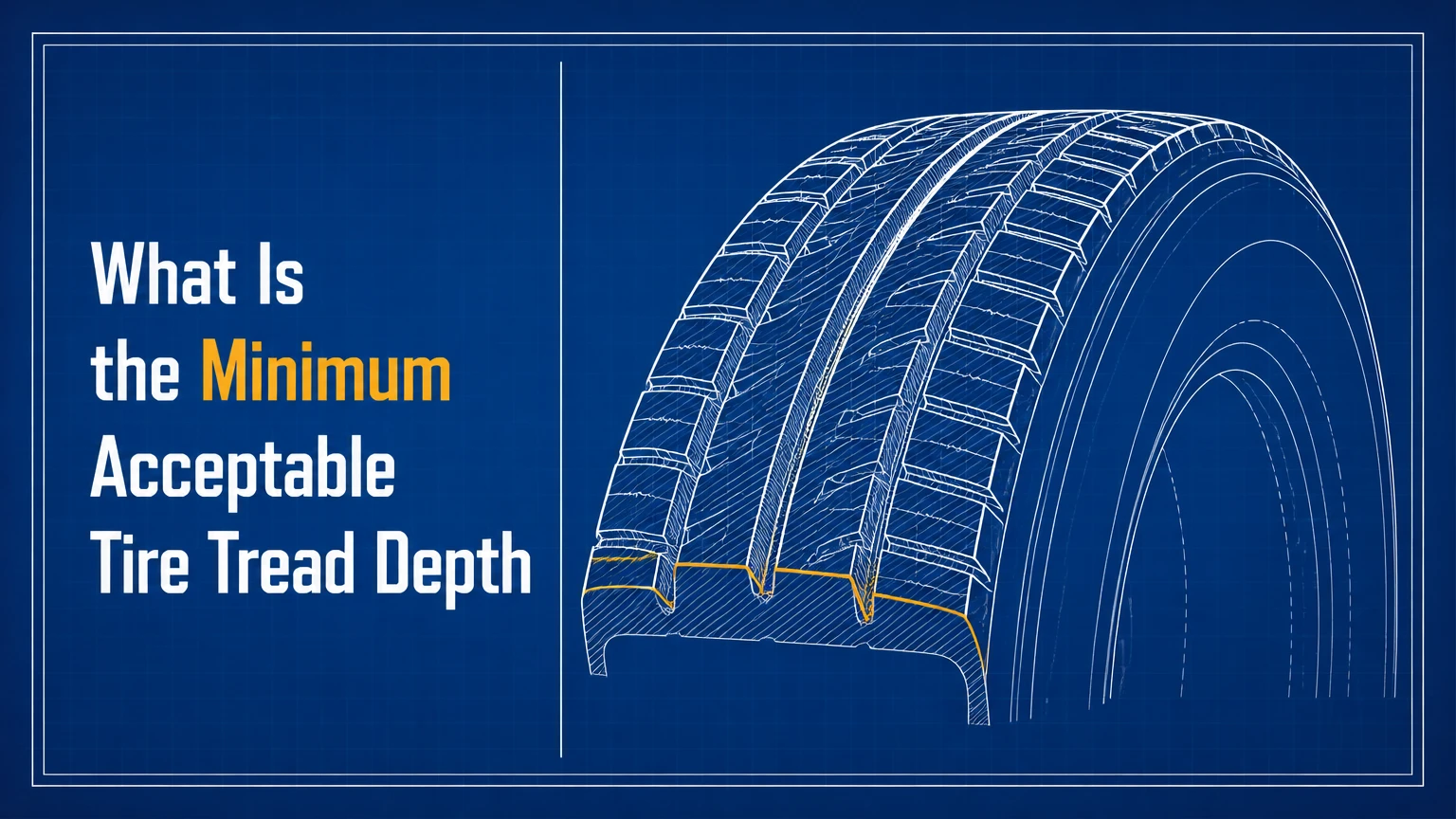
The minimum acceptable tire tread depth for standard passenger vehicles is 2/32 of an inch, which equals 1.6 millimeters, in most global jurisdictions. Operating a motor vehicle below this threshold violates legal safety standards, drastically reduces wet-weather traction, and significantly increases stopping distances on slick road surfaces.
At a Glance
- The standard legal minimum for passenger cars across most US states, Canada, and Europe is 2/32 of an inch (1.6mm).
- Winter tires require a deeper minimum of 4/32 of an inch (3.2mm) to grip snow and slush effectively.
- The traditional penny test provides a basic visual check, but professional digital gauges offer precise millimeter measurements.
- Wet-weather performance and hydroplaning resistance begin to degrade severely when tread depth reaches 4/32 of an inch.
- Tires older than six to ten years can suffer structural rubber degradation regardless of remaining tread depth.
What Are the Legal Minimums for Tire Tread Depth?
The legal minimum for passenger car tire tread depth is 2/32 of an inch (1.6mm) in the United States, Canada, the European Union, and most Asian countries. Law enforcement and state inspection stations use this specific measurement as the boundary between a road-legal tire and an illegal, hazardous component. When the tread blocks wear down to this 1.6mm threshold, the tire can no longer displace water efficiently.
Local transportation authorities enforce this limit to prevent loss of control on public highways. Driving below this limit can result in traffic citations, failed vehicle inspections, and denied insurance coverage following an accident. Commercial trucks, motorcycles, and passenger cars often fall under different regulatory tiers depending on vehicle weight and axle configuration.
What Is the Winter Tire Exception for Tread Depth?
Winter tires require a minimum tread depth of 4/32 of an inch (3.2mm) to maintain functional traction in snow, ice, and slush. While 2/32 of an inch satisfies legal requirements for summer and all-season tires, it proves entirely inadequate for winter conditions. Winter tires rely on deep sipes and biting edges to pack snow and generate friction; once the tread wears down to 3.2mm, those micro-channels lose their capacity to clear winter precipitation.
Regions with severe winter climates, such as specific Canadian provinces and European mountain passes, legally mandate 4/32 of an inch or higher during designated winter months. Motorists driving on snow-covered roads with standard all-season tires worn below 4/32 of an inch face drastically extended braking distances and compromised steering response.
What Are the Tire Tread Requirements for Commercial Vehicles?
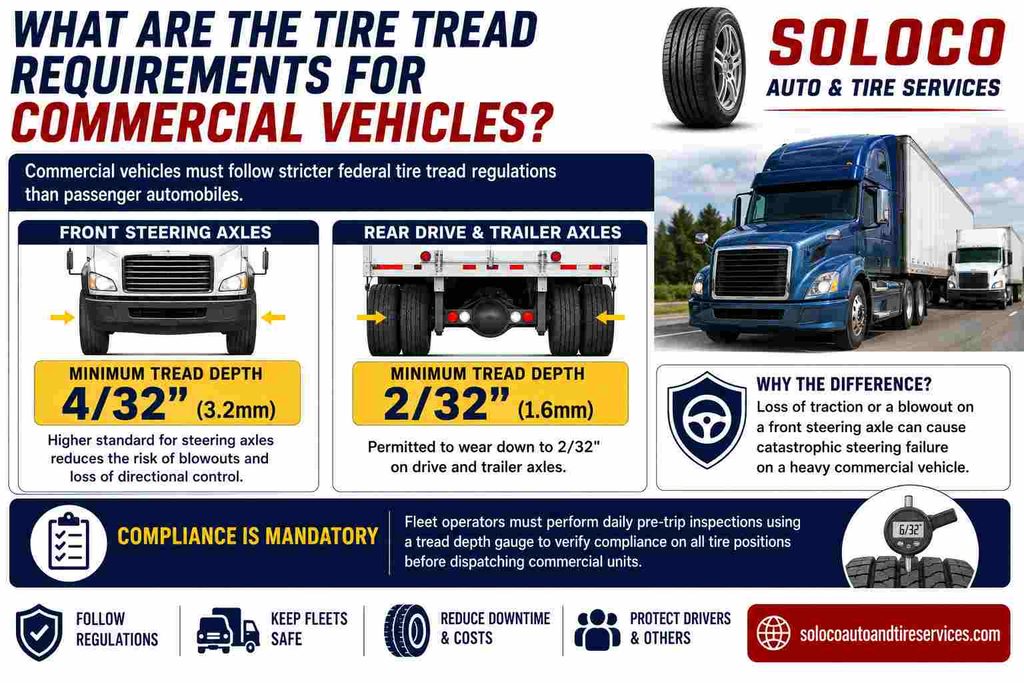
Commercial vehicles, including semi-trucks, delivery vans, and buses, must adhere to stricter federal tire tread regulations than passenger automobiles. Front steering axles on commercial commercial motor vehicles require a minimum tread depth of 4/32 of an inch (3.2mm). Rear drive and trailer axles on these same commercial vehicles are permitted to wear down to 2/32 of an inch (1.6mm).
Regulatory bodies enforce higher standards on steering axles because a front tire blowout or loss of directional traction on a heavy commercial truck causes catastrophic steering failure. Fleet operators conduct mandatory daily pre-trip inspections using specialized tread depth gauges to verify compliance across all tire positions before dispatching commercial units.
How Does the Penny Test Work and Why Does It Fail?
The penny test involves placing a standard US Lincoln penny upside down into the deepest tread groove of a tire. If the top of President Lincoln’s head remains visible above the rubber tread, the tire has less than 2/32 of an inch of tread remaining and requires immediate replacement.
This traditional visual check fails modern driving standards because it only tests for absolute legal baldness rather than optimal safety performance. Waiting until Lincoln’s head is exposed means the driver has already lost significant wet-weather braking performance. Furthermore, uneven wear patterns across the tire width can render a penny test invalid if the technician inserts the coin into a slightly deeper groove while the shoulder remains completely bald.
How Does Tread Depth Affect Wet-Weather Driving and Hydroplaning?
Hydroplaning occurs when a wedge of water builds up beneath the tire contact patch, lifting the vehicle off the pavement and causing a complete loss of steering and braking control. Deep tire grooves act as drainage channels that pump water away from the contact patch at speed.
As tread depth decreases from 8/32 of an inch down to 4/32 of an inch, stopping distances on wet roads increase by up to 40 percent. When tread depth reaches the legal minimum of 2/32 of an inch, the remaining channels cannot evacuate water fast enough during moderate to heavy rainfall. Drivers traveling at highway speeds on tires worn to 2/32 of an inch experience sudden hydroplaning with very little warning.
How Does Tire Age Impact Safety Regardless of Tread Depth?
Tire age compromises structural integrity through chemical oxidation and rubber hardening, even if the tread depth measures a healthy 8/32 of an inch. Rubber compounds contain softening oils and anti-ozonants that evaporate over time when exposed to UV light, heat, and atmospheric oxygen.
Automotive manufacturers and safety agencies recommend inspecting tires annually after five years of service and replacing all tires that exceed ten years from their Department of Transportation (DOT) manufacturing date. An aged tire with ample tread depth remains vulnerable to internal belt separation, sidewall cracking, and sudden tread detachment at high highway speeds.
What Problems Are Caused by Uneven Tire Wear?
Uneven tire wear occurs when mechanical misalignment, improper inflation pressures, or worn suspension components cause specific sections of the tread to wear out faster than others. Common wear patterns include center wear from over-inflation, shoulder wear from under-inflation, and cupping or feathering caused by worn shock absorbers or bad wheel alignment.
When a tire wears unevenly, the vehicle loses balanced contact with the road surface, leading to vibrations, pulling to one side, and premature tire failure. Measuring only the center tread groove hides severe inner or outer shoulder baldness, leaving the vehicle unsafe despite appearing legal at a quick glance.
Do High-Performance Slick Tires Perform Better on Dry Tracks?
High-performance slick tires and heavily worn street tires generate superior grip on bone-dry, heated asphalt because patternless rubber maximizes the surface area contact patch with the road. Racing slicks lack tread grooves entirely for this exact reason.
However, this dry-track advantage turns into a catastrophic disadvantage the moment moisture touches the pavement. Without grooves to channel water, a slick tire loses all friction immediately upon encountering standing water or a sudden rain shower. Street-legal tires require functional tread patterns to balance dry grip with wet-weather safety.
What Is the Spare Tire Trap Regarding Tread Depth and Age?
The spare tire trap describes a dangerous scenario where a motorist installs a brand-new spare tire that has spent a decade stored in a dark trunk, assuming it is safe because the tread depth is pristine. While unused spare tires retain full physical depth, the rubber compounds degrade chemically over years of temperature fluctuations and lack of flexing.
When subjected to the sudden weight and rotational forces of highway driving, an aged spare tire often suffers catastrophic tread separation. Vehicle owners must inspect their spare tires every few years and replace them after a decade, regardless of how rarely the spare has touched the road.
Do I Need to Replace All Four Tires If Only One Is Worn Down?
All-Wheel Drive (AWD) vehicles require the replacement of all four tires simultaneously if one tire is severely worn or damaged. Different tire circumferences between a new tire and worn tires create speed differentials in the wheel rotation sensors, forcing the vehicle’s center differential or transfer case to work constantly and resulting in expensive mechanical failure.
Front-Wheel Drive (FWD) and Rear-Wheel Drive (RWD) vehicles permit replacing tires in pairs on the same axle. Technicians always install the new tires on the rear axle of a passenger vehicle to maintain stability and prevent sudden oversteer during emergency braking or cornering maneuvers.
What Are Built-In Tread Wear Indicators and How Do They Work?
Built-in tread wear indicators, commonly known as wear bars, are narrow strips of solid rubber molded across the bottom of the main tread grooves at a height of 2/32 of an inch. As the tire tread wears down over thousands of miles, these rubber bars eventually become flush with the surrounding tread blocks.
When the wear bars connect smoothly from one side of the tread to the other, the tire has reached the legal minimum depth and must be retired immediately. These visual markers allow drivers and law enforcement officers to check tire condition without needing specialized measuring tools.
How Fast Does Tire Tread Depth Disappear Over Time?
Passenger car tires lose approximately 1/32 of an inch of tread depth every 3,000 to 5,000 miles under normal driving conditions. Total tire lifespan depends directly on driving habits, vehicle weight, tire compound softness, wheel alignment precision, and monthly tire rotation schedules.
Aggressive acceleration, heavy braking, and sharp cornering accelerate rubber wear across all four positions. Drivers who monitor tire pressure monthly and rotate tires every 6,000 miles maximize their tread longevity and maintain predictable handling throughout the tire’s operational lifecycle.
How Do You Measure Tread Depth Accurately Using a Digital Gauge?
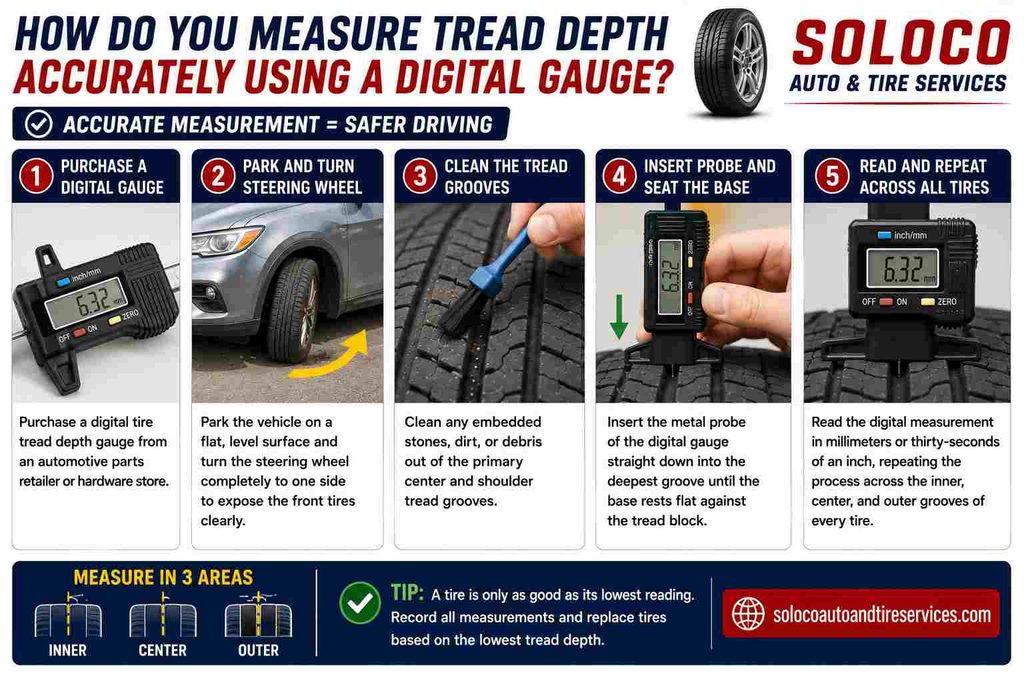
- Purchase a digital tire tread depth gauge from an automotive parts retailer or hardware store.
- Park the vehicle on a flat, level surface and turn the steering wheel completely to one side to expose the front tires clearly.
- Clean any embedded stones, dirt, or debris out of the primary center and shoulder tread grooves.
- Insert the metal probe of the digital gauge straight down into the deepest groove until the base rests flat against the tread block.
- Read the digital measurement in millimeters or thirty-seconds of an inch, repeating the process across the inner, center, and outer grooves of every tire.
The Bottom Line
Maintaining a minimum tire tread depth of at least 2/32 of an inch is a legal necessity, but relying solely on this baseline exposes drivers to severe wet-weather risks. Winter conditions demand 4/32 of an inch, while structural tire aging renders old rubber dangerous regardless of remaining depth. Regular manual inspections using digital gauges or wear bars ensure optimal safety on the road.