Tires must be replaced when the tread depth wears down to 2/32 of an inch, which serves as the legal minimum standard in most jurisdictions. However, drivers should replace tires at 4/32 of an inch for safe wet-weather performance and at 5/32 of an inch for navigating heavy snow and winter slush.
At a Glance
- 2/32 Inch (1.6 mm): The absolute legal minimum threshold across most states and countries where tires must be discarded.
- 4/32 Inch (3.2 mm): The critical safety threshold required to prevent hydroplaning during heavy rainstorms.
- 5/32 Inch (4.0 mm): The recommended minimum depth for maintaining traction in heavy snow and winter slush.
- 6 to 10 Years: The maximum chronological age limit for tire rubber, regardless of remaining tread depth.
- Axle Matching: AWD vehicles require four-wheel replacement, while 2WD vehicles must place new tires on the rear axle.
What is the legal minimum tread depth for car tires?
The legal minimum tread depth for passenger car tires is 2/32 of an inch, equivalent to 1.6 millimeters. Law enforcement and vehicle inspection stations use this specific measurement to determine if a tire is legally bald.
When tread blocks wear down to this limit, the tire loses its ability to channel water away from the contact patch. While passing a state inspection at 2/32 of an inch means a vehicle is legally compliant, it does not mean the vehicle is safe for emergency maneuvers or wet weather. Drivers operating vehicles at this threshold experience severely compromised braking distances on damp asphalt.
How do you measure tread depth accurately without guessing?
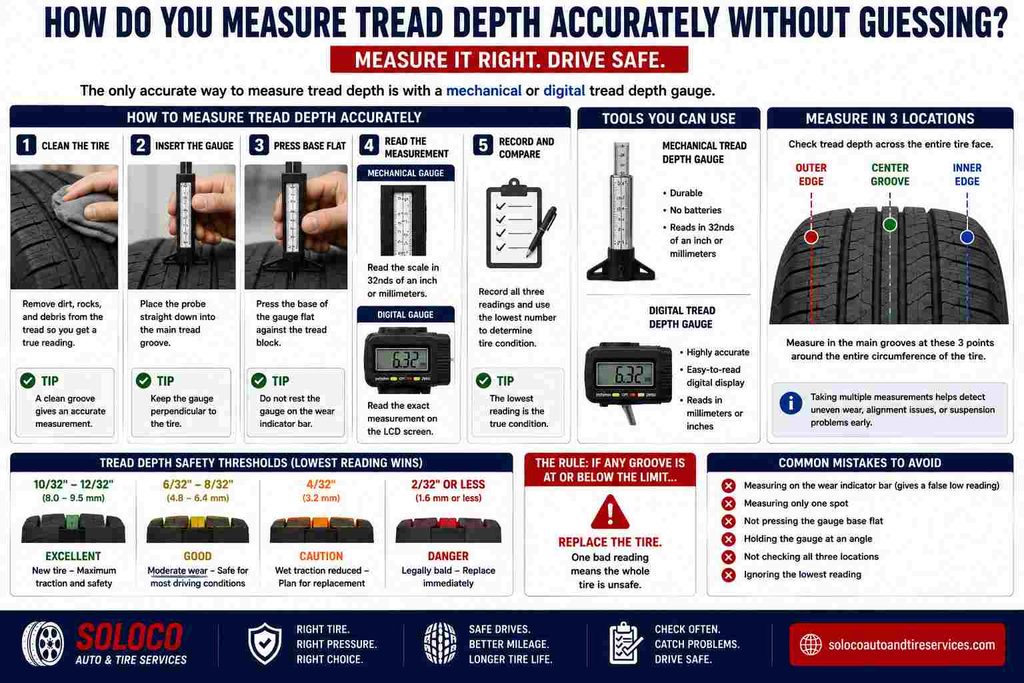
To measure tread depth accurately, use a mechanical or digital tire tread depth gauge inserted directly into the primary tread grooves. Mechanical depth gauges feature a small metal probe that extends into the groove and displays measurements in thirty-seconds of an inch or millimeters.
Digital gauges offer higher precision by providing exact digital readouts on an LCD screen. Technicians recommend taking measurements across three distinct points of the tire face: the outer edge, the center groove, and the inner edge. If any single groove reads at or below safety thresholds, the entire tire requires replacement regardless of how the other sections measure.
How do built-in tread wear indicators work?
Built-in tread wear indicators are raised rubber bars molded directly into the primary drainage grooves of the tire. These bars sit at a uniform height of 2/32 of an inch from the bottom of the groove.
As the surrounding tread rubber wears down over thousands of miles of driving, these indicator bars eventually become flush with the surface of the tread block. When drivers notice rubber bars bridging the gap across the tread pattern, the tire has reached the legal limit and must be replaced immediately. These indicators provide a reliable visual cue without requiring external measuring tools.
What do the penny test and quarter test actually tell you?

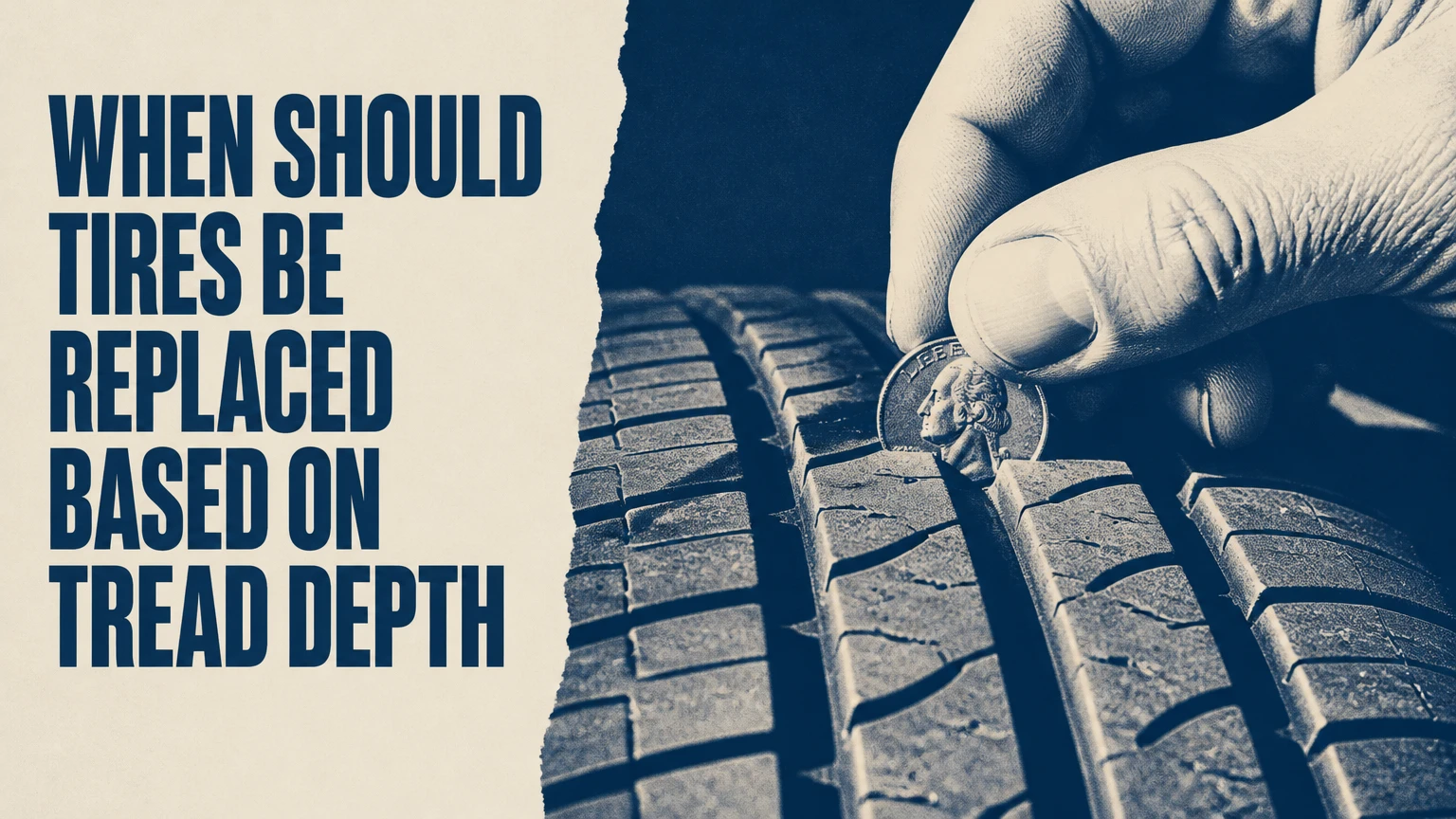
The penny test tells you whether a tire has reached the 2/32-inch legal minimum, while the quarter test tells you if the tread has dropped below the safer 4/32-inch wet-weather threshold.
To perform the penny test, insert a standard penny upside down into the deepest tread groove with Abraham Lincoln’s head facing downward. If the top of Lincoln’s head remains visible, the tread depth is below 2/32 of an inch.
To perform the quarter test, insert a quarter upside down with George Washington’s head facing downward. If the top of Washington’s head is visible, the tread is below 4/32 of an inch. Automotive safety experts advise discarding the penny test in favor of the quarter test because modern tires require more than 2/32 of an inch to stop safely on wet roads.
Why is 4/32 inch recommended for wet weather instead of 2/32 inch?
The 4/32-inch threshold is recommended for wet weather because tires lose a significant amount of water evacuation capacity as tread grooves shallow out. When driving on wet pavement at speeds above 45 miles per hour, tires must channel gallons of water per minute through their grooves to maintain contact with the road surface.
At 2/32 of an inch, water cannot escape fast enough, causing a wedge of water to form beneath the contact patch. This phenomenon, known as hydroplaning, causes the vehicle to lift off the pavement and completely lose steering and braking control. Maintaining a minimum depth of 4/32 of an inch preserves adequate channel volume to prevent hydroplaning during heavy downpours.
When do winter tires lose their specialized snow grip?
Winter tires lose their specialized snow grip once the tread wears down to snow platforms, which typically sit between 5/32 and 6/32 of an inch. Winter tire manufacturers design these tires with high sipes and deep rubber blocks packed with micro-pumps to bite into ice and packed snow.
Unlike standard all-season tires that wear down to 2/32 of an inch safely for dry roads, winter tires become ineffective long before reaching that legal minimum. Once the dedicated winter snow platforms wear flat with the surrounding tread, the tire functions merely as an inferior summer tire in cold conditions. Drivers should replace winter tires as soon as the tread hits these raised internal indicator bars.
How does tire age affect replacement urgency regardless of tread?
Tire age affects replacement urgency because rubber compounds degrade chemically over time due to oxidation, heat cycles, and ultraviolet radiation. Even if a vehicle sits parked in a garage with deep tread remaining, the volatile oils inside the rubber evaporate, causing the sidewalls and tread blocks to become brittle.
Industry experts recommend replacing all tires after six years from the date of manufacture, with a hard cutoff at ten years regardless of appearance. Microscopic cracking, known as dry rot, develops in the rubber matrix and compromises the structural integrity of the internal steel belts, making the tire vulnerable to catastrophic separation at highway speeds.
What tire damage requires immediate replacement despite deep tread?
Any sidewall bulging, bubble formation, deep cut exposing cords, or puncture larger than one quarter inch in the tread requires immediate tire replacement regardless of remaining tread depth. Pothole impacts and curb strikes frequently pinch the internal polyester casing cords, causing structural failure that manifests as a bubble on the sidewall.
A sidewall bubble indicates that compressed air is pressing directly against the thin outer rubber layer, creating an imminent blowout risk. Similarly, driving on a tire with low pressure can damage the inner liner beyond safe repair limits, requiring a new tire even if the tread measures a healthy 8/32 of an inch.
How do underinflation and overinflation cause uneven wear?
Underinflation causes excessive wear on both the inner and outer shoulders of the tire, while overinflation causes rapid wear down the center strip of the tread. When a tire lacks proper air pressure, the vehicle’s weight rests heavily on the outer edges, causing the shoulders to scrub against the pavement during cornering.
Conversely, when a tire contains too much air pressure, the center of the tread balloons outward and absorbs the majority of the vehicle load. Both conditions drastically reduce the usable lifespan of the tire and create unsafe handling characteristics. Maintaining correct tire pressure levels specified on the door jamb placard ensures even contact patch pressure and uniform tread wear.
How do you read a tire manufacturing date code?
To read a tire manufacturing date code, locate the Department of Transportation serial number stamped into the lower sidewall and examine the final four digits. The letters DOT precede a string of characters, ending with a four-digit block that reveals the exact production timeline.
The first two digits represent the week of manufacture, ranging from 01 through 52, while the final two digits designate the production year. For example, a code ending in 2424 indicates that the tire was manufactured during the twenty-fourth week of the year 2024. Consumers buying replacement tires should always check this code to ensure they are not purchasing old stock sitting in a warehouse.
Do I need to replace all four tires at once on AWD vehicles?
All-wheel-drive and four-wheel-drive vehicles require all four tires to be replaced at the same time to prevent severe mechanical damage to the drivetrain. AWD systems utilize center differentials and transfer cases designed to manage tiny speed variations between the front and rear axles during normal turning.
If one tire has significantly less tread than the others, its overall rolling circumference decreases, causing that wheel to spin faster than the rest. This constant speed mismatch forces the center differential clutches or gears to work overtime, generating excessive heat that can permanently destroy the transfer case. Most manufacturers specify that all four tires must remain within a two-thirty-seconds or four-thirty-seconds inch tread depth variance.
Where should new tires be installed on a two-wheel-drive car?
New tires on a two-wheel-drive vehicle must always be installed on the rear axle, regardless of whether the car is front-wheel-drive or rear-wheel-drive. Putting new tires on the rear axle ensures maximum grip on the back wheels, which prevents dangerous oversteer and fishtailing on wet or slick roads.
If worn tires sit on the rear axle during a sudden emergency braking maneuver or a sharp turn on a wet highway, the rear end of the car loses traction first. Rear-wheel slide is extremely difficult for average drivers to correct, whereas front-wheel slide causes understeer that is easier to manage. Tire shops routinely move newer rear tires to the front and install brand-new tires on the rear axle.
Does driving on low tread depth improve fuel economy?
Driving on low tread depth slightly improves fuel economy because worn tires create less rolling resistance than brand-new tires with deep tread blocks. Brand-new tires feature deep tread blocks that flex under the weight of the vehicle, consuming small amounts of engine energy through internal friction.
As the tread wears down and becomes smoother, the tire flexes less and rolls across the pavement with minimal resistance. However, this microscopic fuel savings comes at an unacceptable safety cost. The minor reduction in fuel consumption is entirely overshadowed by the catastrophic loss of braking friction, increased stopping distances, and high risk of wet-weather hydroplaning.
What are the legal and safety risks of driving on bald tires?
Driving on bald tires creates severe legal liabilities, including potential traffic citations, failed state vehicle inspections, and denied insurance coverage following weather-related accidents. Legally, operating a vehicle with tread depth below 2/32 of an inch constitutes a traffic violation in most regions, carrying monetary fines and points on a driver’s license.
From a safety perspective, bald tires increase braking distances on wet pavement by hundreds of feet compared to new tires. In the event of a collision caused by failure to stop in wet conditions, insurance investigators examining tire condition can deny claims if negligence due to worn equipment is established. Replacing tires before they reach the bald stage protects both personal safety and legal standing.
The Bottom Line
Determining when to replace tires based on tread depth requires looking past the basic 2/32-inch legal minimum and focusing on real-world safety limits. Drivers navigating wet climates should replace tires at 4/32 of an inch to prevent hydroplaning, while maintaining strict adherence to age limits and drivetrain requirements. Prioritizing proactive tire replacement preserves essential braking traction and prevents catastrophic road failures.