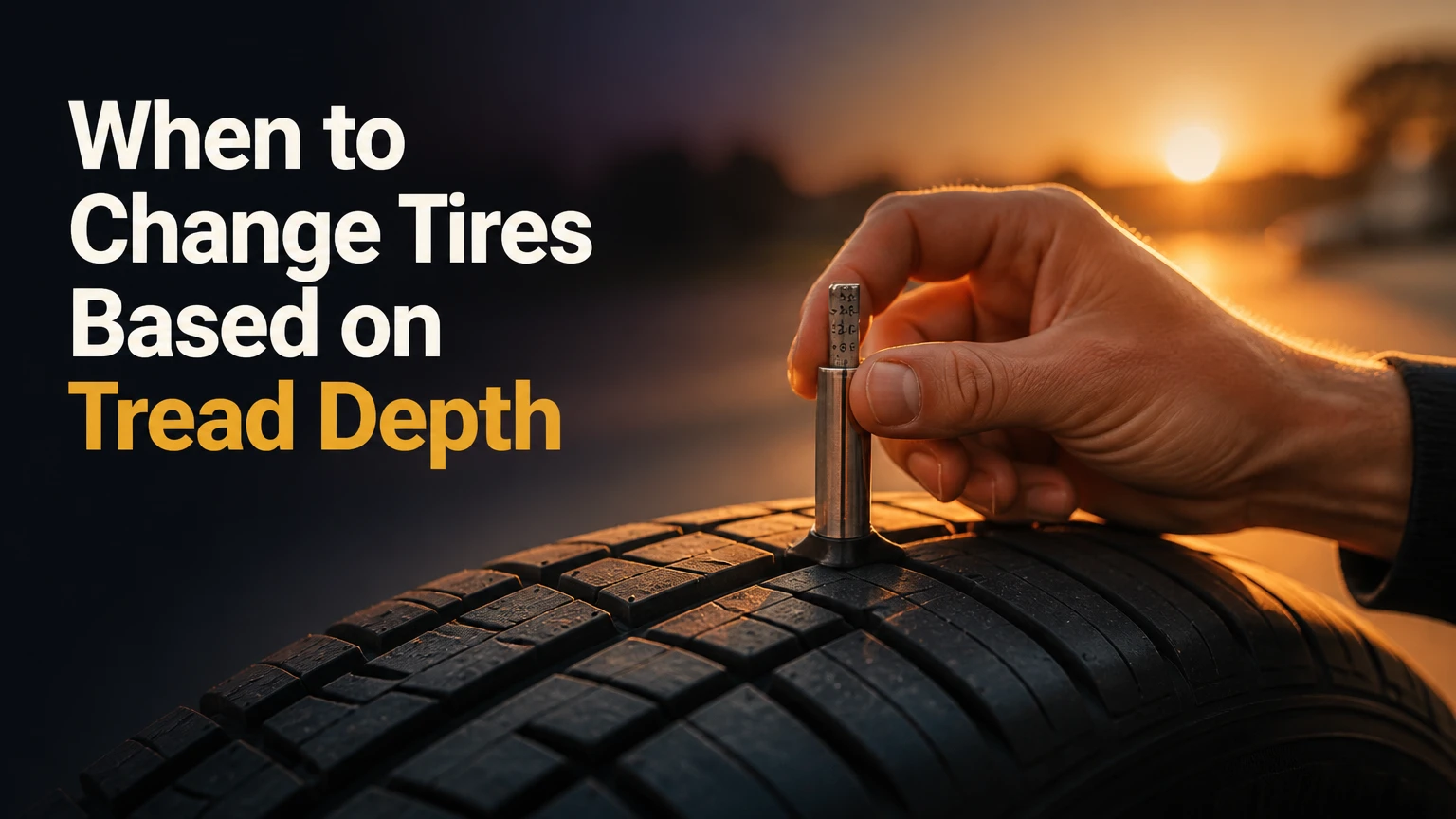
Vehicle tires must be replaced when the tread depth reaches the legal minimum limit of 2/32 of an inch or 1.6 millimeters, or earlier when specialized safety thresholds for wet roads and snow are breached. Drivers should utilize dedicated manual depth gauges, coin tests, or built-in wear indicators to inspect tires across all grooves regularly.
At a Glance: Essential Tire Tread Facts
- 2/32 Inches (1.6 mm): The absolute legal minimum limit where tires are considered legally bald and must be replaced immediately.
- 4/32 Inches (3.2 mm): The critical safety threshold for wet roads where hydroplaning risk spikes and stopping distances double.
- 5/32 Inches (4.0 mm): The minimum depth required for winter tires to effectively grip and compress snow.
- Coin Tests: Inserting a US quarter or penny upside down into the tread quickly reveals remaining depth without a tool.
- Lowest Point Rule: Tires must always be replaced based on the most worn spot across the tread, not the average depth.
- Age Limit: Tires older than six to ten years must be replaced due to rubber degradation, regardless of remaining tread.
What is the legal minimum tire tread depth?
The legal minimum tire tread depth in most states, provinces, and countries is 2/32 of an inch, which equals 1.6 millimeters. Operating a vehicle with tread depth at or below this limit violates traffic regulations and creates severe safety hazards. Law enforcement and vehicle inspection stations use this exact dimension as the cutoff for roadworthiness.
When a tire reaches 2/32 of an inch, the rubber compound is exhausted. The tire loses its ability to grip the pavement, channel water away from the contact patch, and maintain vehicle control during sudden braking or cornering maneuvers. Drivers caught operating vehicles below this threshold face traffic citations, failed vehicle inspections, and dramatically increased crash risks.
What do tread depth numbers like 2/32 and 10/32 mean?
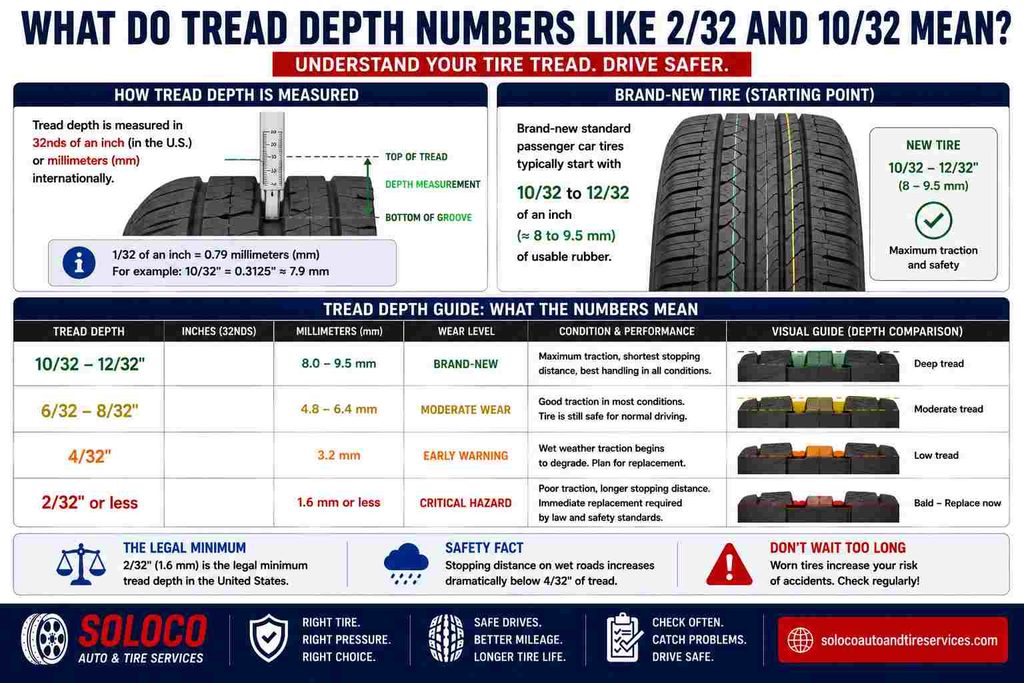
Tire tread depth is measured in 32nds of an inch in the United States and millimeters internationally. Brand-new standard passenger car tires typically start with a tread depth between 10/32 and 12/32 of an inch, which translates to roughly 8 to 9.5 millimeters of usable rubber.
As a vehicle travels thousands of miles, friction with the road surface wears away this rubber layer. Understanding these fractional measurements helps drivers track degradation over time:
- 10/32 to 12/32 inches: Brand-new tire condition with maximum traction capabilities.
- 6/32 to 8/32 inches: Moderate wear level; the tire still performs well in most normal weather conditions.
- 4/32 inches: Early warning threshold; wet weather traction begins to degrade significantly.
- 2/32 inches: Critical hazard level; immediate replacement is required by law and safety standards.
How can you measure tire tread depth using a quarter or a penny?
You can measure your tire tread depth without a digital tool by using standard US coins inserted into the primary tread grooves. The quarter test indicates the 4/32-inch safety threshold, while the penny test indicates the 2/32-inch legal minimum limit.
To perform the Quarter Test, insert a US quarter upside down into the shallowest tread groove, with Washington’s head facing down. If the top of Washington’s head remains fully visible, your tread depth is less than 4/32 of an inch, signaling that you should plan for tire replacement soon.
To perform the Penny Test, insert a US penny upside down into the groove with Lincoln’s head facing down. If the top of Lincoln’s head is completely visible, your tread depth has dropped below 2/32 of an inch. This means your tires are legally bald, and you must replace them immediately. Always test multiple spots across the width of the tire to check for uneven wear patterns.
How do you use a mechanical tread depth gauge accurately?
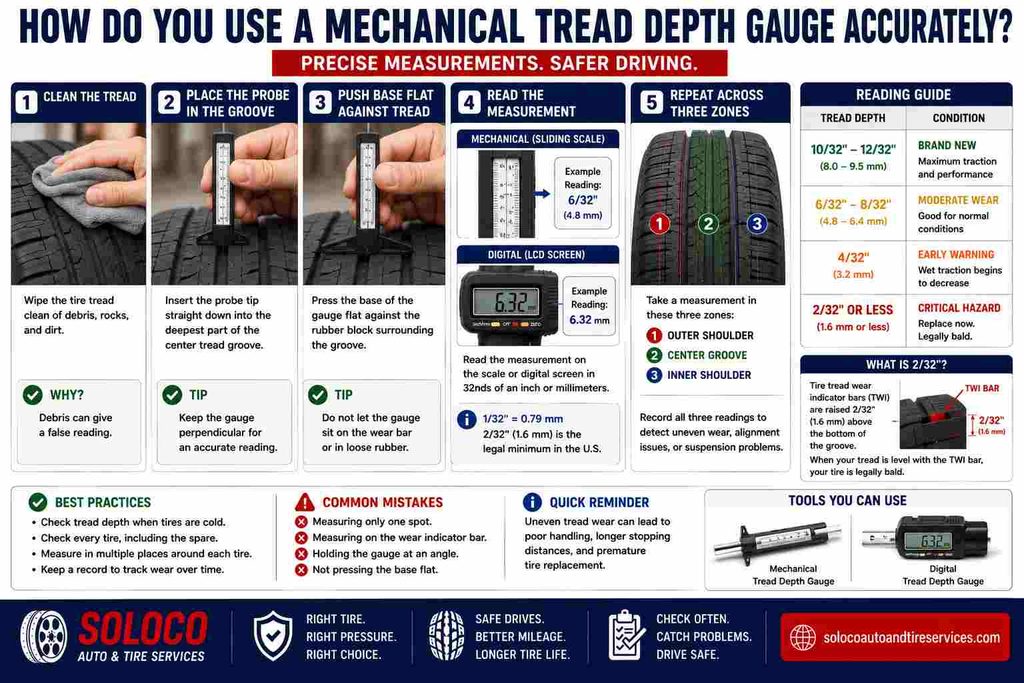
A mechanical or digital tread depth gauge provides precise measurements down to the thousandth of an inch. To use a manual probe gauge, wipe the tire tread clean of debris, rocks, and dirt that could skew the measurement. Place the probe tip directly into the deepest center tread groove of the tire.
Push the base of the gauge flat against the rubber block surrounding the groove. Read the measurement on the sliding scale or digital screen in 32nds of an inch or millimeters. Repeat this process across three distinct zones of each tire: the outer shoulder, the center groove, and the inner shoulder. Documenting these three measurements helps identify alignment issues or suspension wear early.
How often should you check your tire tread depth?
Drivers should check their tire tread depth at least once every month and immediately before embarking on long road trips. Monthly checks take less than five minutes and ensure that gradual wear does not catch you by surprise during seasonal weather changes.
In addition to monthly checks, you should inspect your tires whenever you wash your vehicle or adjust your tire pressure. Changing seasons also serve as reliable reminders. Checking tread depth every autumn prepares your vehicle for wet autumn leaves and winter snow, while spring checks evaluate how well your tires survived winter potholes and road salt.
What are the raised bumps inside tire grooves and how do they work?
The raised rubber bars molded inside the primary tread grooves are called Tread Wear Indicator bars, or TWI bars. These horizontal bars are manufactured at a height of exactly 2/32 of an inch from the bottom of the groove. They remain recessed and invisible on brand-new tires.
As the surrounding tread rubber wears down over thousands of miles, the TWI bars gradually flush level with the surface of the tread block. When you notice these rubber bridges connecting two adjacent tread ribs across the width of the tire, your tire has reached the legal 2/32-inch limit. Seeing these bars means the tire is fully spent and must be taken out of service immediately.
Why do winter tires need replacement at higher tread depths?
Winter tires require replacement when tread depth reaches 6/32 to 5/32 of an inch, long before they hit the standard 2/32-inch legal limit. Winter tire performance relies on a specialized, soft rubber compound and deep sipes designed to pack and grip snow.
Once a winter tire wears down past 5/32 of an inch, the specialized winter compound is completely gone, leaving only the harder base rubber underneath. Furthermore, shallow winter grooves lose their ability to self-cleaning snow and ice. A winter tire worn to 3/32 of an inch will perform significantly worse in snow than a standard all-season tire at the same depth, compromising your safety in winter conditions.
What causes uneven tire wear and how does it affect replacement timing?
Irregular tire wear is caused by mechanical problems such as incorrect wheel alignment, worn suspension components, improper tire inflation pressure, or neglected tire rotations. When a vehicle suffers from excessive toe-in or camber issues, one edge of the tire may wear down to 0/32 inches while the center maintains 6/32 inches of tread.
Tires must always be replaced based on the lowest depth point measured anywhere across the entire tread width, not the average depth. If one shoulder is completely bald due to bad alignment, the entire tire is unsafe and illegal to drive on, regardless of how much tread remains on the rest of the contact patch. Always inspect the inner edge of your tires, as negative camber settings often cause hidden wear in that zone.
When do tires need to be replaced due to age rather than tread depth?
Tires must be replaced due to chemical aging when they reach six to ten years of age, regardless of how much tread depth remains. Rubber compounds degrade over time due to exposure to ultraviolet light, heat, ozone, and oxygen, causing microscopic cracks known as dry rot to form on the sidewalls and tread blocks.
You can determine the exact age of your tire by locating the Department of Transportation code on the sidewall, which begins with the letters DOT followed by a four-digit number. The first two digits represent the week of manufacture, and the last two digits represent the year. For example, a code ending in 2422 indicates the tire was manufactured during the 24th week of 2022. Tires exceeding eight years of age should be replaced by a professional technician even if they look healthy.
At what exact tread depth does hydroplaning risk increase on wet roads?
Hydroplaning risk increases dramatically when tire tread depth drops below 4/32 of an inch on wet roads. While 2/32 of an inch is the legal minimum, a tire at 2/32 cannot channel standing water away fast enough at highway speeds, causing a wedge of water to lift the rubber off the asphalt surface.
Testing data demonstrates that vehicle stopping distances on wet roads double once tires wear below 4/32 of an inch. At this threshold, water evacuation channels lose roughly half their volume capacity. Driving through heavy rain or puddles with tires at 3/32 or 2/32 inches transforms your vehicle into a skimming sled with virtually no steering or braking authority.
Do you need to replace all four tires at once on an all-wheel drive vehicle?
All-Wheel Drive vehicles require all four tires to be replaced at the same time, or within very strict rolling circumference tolerances of typically 2/32 to 4/32 of an inch. AWD systems utilize center differentials and transfer cases that constantly monitor wheel speed differences between the front and rear axles.
Mixing a brand-new tire with three worn tires creates a difference in overall tire rolling circumference. This size discrepancy forces the center differential to spin continuously to compensate for the speed mismatch, generating excessive heat and mechanical friction. Over time, this constant strain destroys expensive AWD drivetrain components, turning a simple tire replacement into a costly transmission repair.
Should new replacement tires go on the front or the rear axle?
Brand-new replacement tires must always be installed on the rear axle, regardless of whether your vehicle is front-wheel drive, rear-wheel drive, or all-wheel drive. Putting new tires on the rear axle ensures maximum grip where vehicle stability is controlled.
When worn tires are placed on the rear during wet weather cornering, the rear wheels lose traction before the front wheels, causing dangerous oversteer or fishtailing that can spin the car out of control. By placing new tires on the rear, the vehicle retains stable rear traction. If the front tires have slightly less tread, understeer occurs instead, which is far easier for an average driver to control by lifting off the throttle.
How does regular tire rotation prevent premature tread wear?
Regular tire rotation prevents premature tread wear by equalizing the rate at which different tires degrade across your vehicle. Front-wheel-drive vehicles wear their front tires significantly faster than rear tires because the front axle handles steering, braking power, and engine propulsion simultaneously.
Rotating your tires every 5,000 to 7,500 miles ensures that every tire spends time in high-wear and low-wear positions over its lifespan. This practice extends the overall operating life of your tire set, prevents irregular cupping wear patterns, and maintains balanced handling characteristics across all four corners of the vehicle.
What are the immediate driving hazards of driving on worn tires below 2/32 inches?
Driving on worn tires below 2/32 inches exposes you to catastrophic safety failures, including loss of directional control, increased hydroplaning, and extended braking distances. On dry pavement, bald tires lack the biting edges required to grip asphalt during panic stops, adding dozens of feet to your stopping distance.
On wet or snowy roads, bald tires cannot displace moisture or bite into loose surfaces, making skids almost inevitable during normal turns. Furthermore, thin tread rubber offers minimal puncture resistance against sharp potholes, glass, or nails, drastically increasing your risk of sudden blowout accidents at highway speeds.
The Bottom Line
Monitoring and managing your tire tread depth is vital for maintaining vehicle safety, stopping power, and road control. Replace your tires immediately when they reach the legal minimum limit of 2/32 of an inch, or proactively at 4/32 of an inch to maintain safe wet-weather performance.
Always prioritize the lowest wear point across your tire, match tire sets on all-wheel-drive systems, and place brand-new tires on the rear axle to prevent hazardous fishtailing.