The date code on a tire is located on the outer or inner sidewall inside a raised rubber box containing the Department of Transportation code. The final four digits of this DOT string represent the exact manufacturing week and year, with the first two digits showing the production week and the last two digits indicating the production year.
At a Glance
- The tire date code is always located at the end of the alphanumeric DOT sequence on the sidewall.
- Post-2000 tires use a four-digit format, where 3124 means the 31st week of 2024.
- Pre-2000 tires use a three-digit format and may feature a small triangle to indicate the 1990s decade.
- Federal regulations only require the full date code to be stamped on one sidewall, meaning it may face inward.
- Most manufacturers recommend replacing tires when they reach six to ten years of age, regardless of remaining tread depth.
Where is the date code on tires?
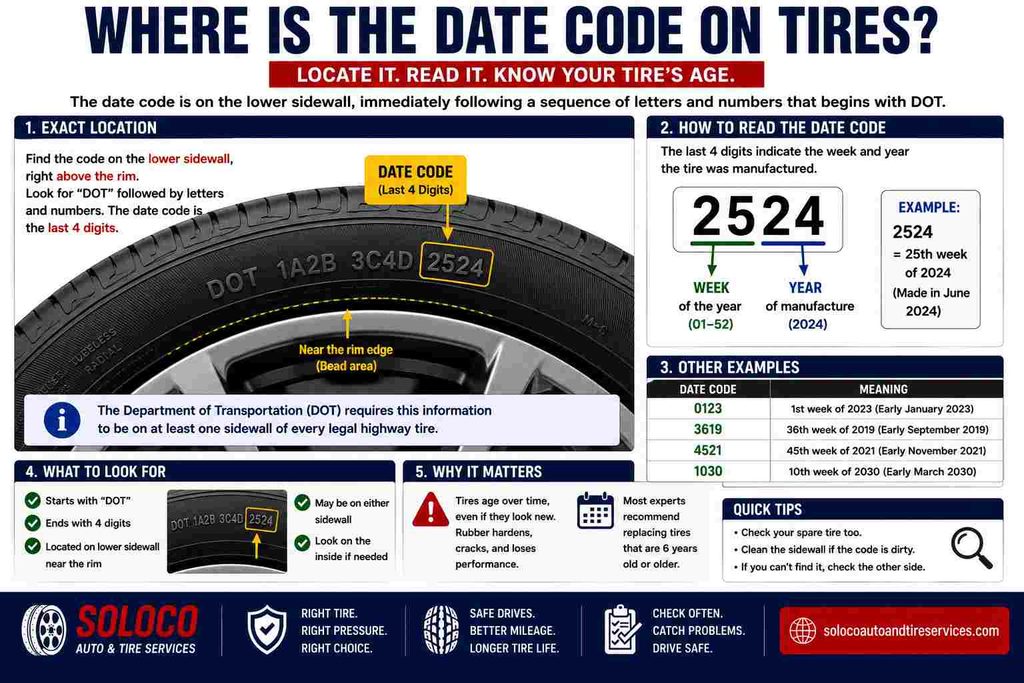
The date code on tires is located on the lower sidewall, immediately following a sequence of letters and numbers that begins with the letters DOT. Vehicle owners can find this code by searching near the wheel rim edge where the rubber meets the metal rim flange.
The Department of Transportation mandates that every legal highway tire manufactured for sale displays this information on at least one sidewall.
How do you read a 4-digit tire date code?
To read a modern 4-digit tire date code, look for the final four numbers at the conclusion of the DOT alphanumeric string. The first two numbers designate the production week of the year, ranging from 01 to 52, while the final two numbers specify the manufacturing year. For example, a code ending in 4321 indicates that the tire was manufactured during the 43rd week of the year 2021.
What do the first 6 to 8 characters of a DOT code mean?
The first six to eight characters of a tire DOT code represent the manufacturing plant code, the tire size code, and the manufacturer internal option code. These initial characters are assigned by the National Highway Traffic Safety Administration to identify the exact factory location where the tire was built. Consumers and technicians ignore these plant and size characters when determining the age of a tire, focusing solely on the final numerical block.
How do you read pre-2000 3-digit tire date codes?
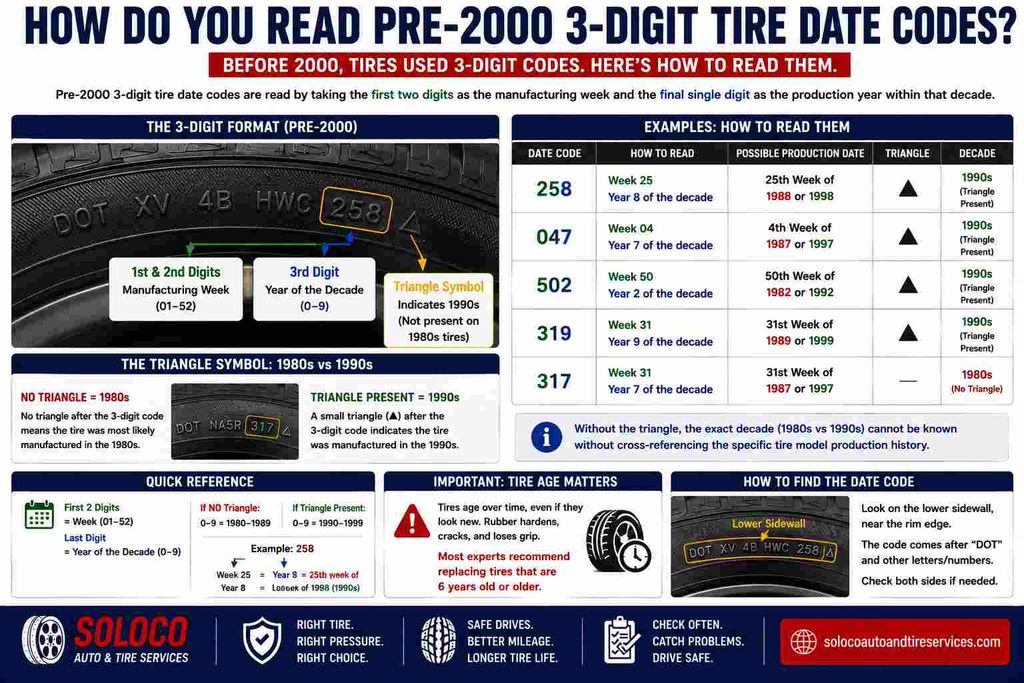
Pre-2000 3-digit tire date codes are read by taking the first two digits as the manufacturing week and the final single digit as the production year within that specific decade. For example, the code 258 indicates the 25th week of 1988 or 1998.
Tires manufactured during the 1990s frequently feature a small triangular symbol located immediately after the three-digit code to distinguish them from tires built during the 1980s. Without this triangle symbol, determining the exact decade requires cross-referencing the specific tire model production run history.
Why is the date code missing on one side of the tire?
A date code appears missing because federal regulations only require tire manufacturers to stamp the full DOT code containing the date on one single sidewall of the tire. The opposite sidewall displays the plant and size identification characters but terminates abruptly before the four-digit date block. When technicians mount tires with the date-stamped side facing inward toward the vehicle suspension, the date code becomes invisible from the outside view. Inspecting these hidden codes requires crawling underneath the vehicle or using a mirror.
How do directional and asymmetric tire mounting affect date code visibility?
Asymmetric and directional tire mounting rules dictate fixed rotation patterns and inside-outside orientations that frequently hide date codes from external inspection. Asymmetric tires feature specific inside and outside sidewalls, meaning a correct installation by a tire shop might place the date code on the interior face. Directional tires are engineered to roll in one specific forward direction, so swapping a tire from the left side of a vehicle to the right side automatically reverses which sidewall faces outward. Consequently, a date code visible on the driver’s side front tire may be hidden on the passenger’s side front tire.
How do you identify the date code on retreaded or remolded tires?
Retreaded tires, commonly used on commercial trucks and select light-duty applications, display a separate DOT-R code stamped into a rubber patch applied during the retreading process. The original DOT date code molded into the casing sidewall reveals the age of the foundational tire body. The secondary retread code indicates the specific week and year when the new tread rubber was bonded to that old casing. Commercial fleet operators must track both the structural casing age and the tread application age to maintain compliance and safety standards.
Why does general advice fail due to curb rash and road grime?
General tire dating advice fails because parallel parking scrapes, curb impacts, and deep road grime routinely obliterate the shallowly raised rubber characters of the DOT code. Heavy accumulations of brake dust, mud, and road salt harden inside the embossed rubber cavities, visually transforming numbers like a three into an eight or a one into a seven. Furthermore, scrubbing these areas with harsh wire brushes or chemical wheel cleaners can shear away the delicate raised edges of the digits, rendering the code completely illegible.
How long do tires last before they are too old to use?
Most major tire manufacturers, vehicle makers, and safety organizations recommend replacing tires when they reach six to ten years of age, regardless of how much tread depth remains. Rubber is an organic and synthetic compound that undergoes continuous chemical degradation over time due to environmental exposure. Even if a vehicle remains parked in a climate-controlled garage with zero road wear, the internal chemical composition degrades, loses elasticity, and presents structural failure risks once it passes the ten-year threshold.
What are the physical warning signs of tire dry rot?
Tire dry rot, scientifically known as thermo-oxidative degradation, manifests as fine surface cracking, crazing, and discoloration across the sidewall and tread grooves. As the natural anti-ozonant waxes inside the rubber compound evaporate, the rubber loses structural flexibility and develops brittle fissures. Deep cracks running parallel to the rim or branching across the tread blocks indicate advanced internal delamination, which drastically increases the risk of a high-speed tread separation blowout.
Do spare tires and trailer tires age the same way as daily driver tires?
Spare tires, trailer tires, and RV tires degrade significantly faster and pose a much higher risk of sudden failure than daily driver tires due to unique environmental stressors. Spare tires tucked beneath truck beds or inside trunk wells experience severe thermal cycling and UV exposure if mounted on exterior racks. Trailer and RV tires sit stationary for months at a time, supporting heavy static loads while absorbing constant ultraviolet radiation at storage yards, which accelerates sidewall aging while leaving tread depth deceptively deep.
Does tire shine or dressing protect against rubber aging?
Chemical tire shines and cosmetic dressings do not protect tires against aging and frequently accelerate thermo-oxidative degradation. Many inexpensive, petroleum or silicone-based tire dressings strip away the rubber compound’s natural anti-ozonant waxes, leaving the sidewall vulnerable to ozone cracking and dry rot. Protective maintenance relies on washing tires with mild soap and water, storing vehicles away from direct sunlight, and avoiding prolonged contact with ozone-producing electric motors.
Is it illegal for a tire shop to sell old or expired tires?
In the United States and most global jurisdictions, no federal or state law prohibits tire retailers from selling aged, unmounted inventory that has sat on warehouse shelves for several years. However, industry trade associations and major tire manufacturers enforce strict voluntary guidelines stating that tires older than six years from the manufacturing date should not be sold as new merchandise without explicit customer disclosure. Consumers retain the right to inspect DOT codes prior to installation and request freshly manufactured inventory.
How long can new tires sit in a warehouse before installation?
New tires routinely sit in climate-controlled distributor and retail warehouses for one to three years before reaching a consumer’s vehicle without suffering significant structural degradation. Proper indoor warehouse storage minimizes exposure to direct sunlight, extreme temperature fluctuations, and ozone-producing machinery. However, consumers purchasing tires that have spent more than three years in distribution inventory should negotiate a discount or request newer stock to maximize their usable operational lifespan on the road.
Can you extend the life of an aging tire with chemical sealants?
Chemical sealants, rubber rejuvenators, and spray coatings cannot reverse structural aging or restore lost elasticity to an expired tire. While aftermarket products can temporarily restore a dark black aesthetic appearance to oxidized rubber, they cannot bond internal steel belts to degraded rubber matrices or heal microscopic sidewall fissures. Once a tire exceeds its safe operational age threshold, physical replacement is the only valid safety remedy.
The Bottom Line
Locating and reading the date code on your tires requires finding the final four digits of the DOT sequence on the sidewall, where the first two numbers indicate the manufacturing week and the last two show the year. Because rubber oxidizes and loses structural integrity over time due to environmental exposure, experts recommend replacing all tires that exceed six to ten years of age regardless of tread depth. Always inspect both sidewalls, verify codes before purchasing new inventory, and prioritize safety over remaining tread wear.